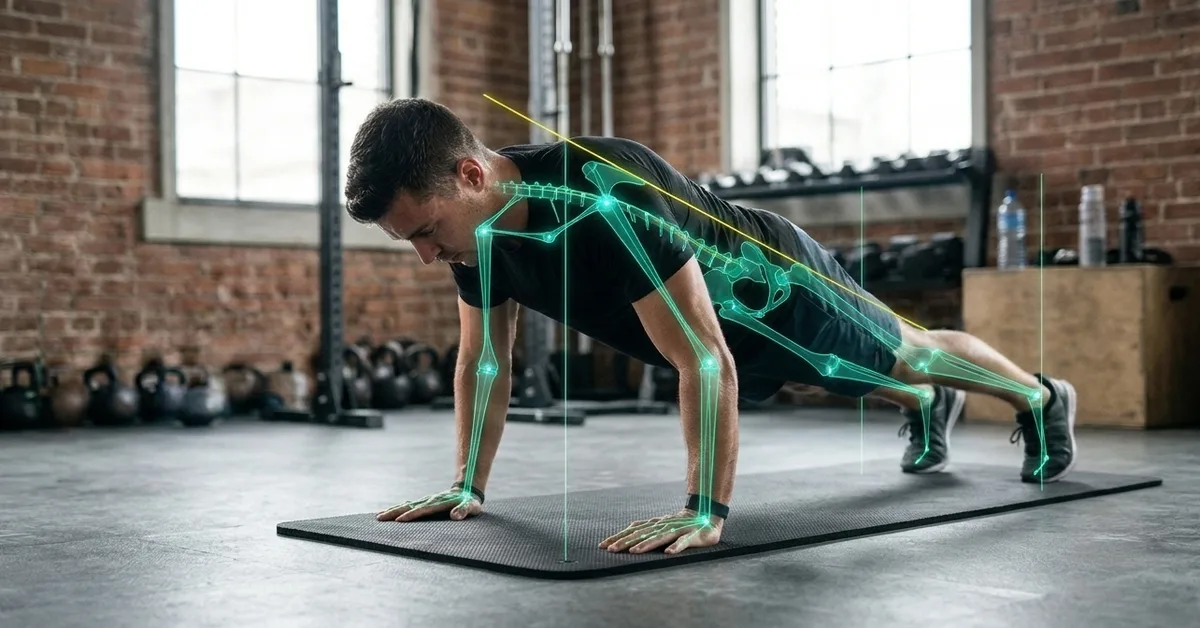
How to do a proper push-up: hand position, elbow angle and body line, the 5 most common mistakes, how many you should do, and how to get better at home.
Quick answer: To do a proper push-up, place your hands slightly wider than your shoulders, make a straight line from your head to your heels, and brace your core and glutes. Lower your chest toward the floor with your elbows at about 45 degrees from your body, not flared out to the sides. Then push the floor away until your arms are straight. Most form problems come from sagging hips, flared elbows and half reps. If you have no trainer to check you, film yourself from the side or use an app like ScrollToll: Screen-Time Gym, which watches your form through your phone's camera and counts every rep at home.
Push-ups need no gym, no equipment and no membership. They work your chest, shoulders, triceps and core at the same time. But a push-up done badly mostly trains your wrists and lower back to hurt. This guide shows exactly what good form looks like, how to spot your own mistakes, and how to go from zero to a solid set.
What muscles do push-ups work?
| Muscle | What it does in a push-up |
|---|---|
| Chest (pectorals) | Does most of the pushing |
| Front of the shoulders (anterior deltoids) | Helps press you up |
| Triceps (back of the arms) | Straightens your elbows at the top |
| Core (abs and obliques) | Holds your body in a straight plank |
| Glutes and thighs | Keep your hips from sagging |
| Serratus anterior (side of the ribs) | Moves your shoulder blades at the top |
That is why push-ups count as a full upper-body and core exercise, not just a chest move. They are also one of the easiest ways to break up long hours of sitting, which matters more than most people think: see how your phone is making you sedentary.
How to do a proper push-up, step by step
- Set your hands: Place them on the floor slightly wider than your shoulders, fingers pointing forward. Your wrists should sit under your shoulders when you are at the top.
- Make a straight line: Step your feet back so your body forms one line from your head through your hips to your heels. Feet together is harder; feet hip-width apart is more stable.
- Brace: Tighten your stomach as if someone is about to poke it, squeeze your glutes and lock your knees. This stops your hips from sagging.
- Lower with control: Bend your elbows and lower your whole body as one piece. Keep your elbows at roughly 45 degrees from your sides, so from above your body looks like an arrow, not a "T". Take about 2 seconds on the way down.
- Go deep enough: Stop when your chest is a fist's height from the floor or lightly touches it. Your elbows should reach at least 90 degrees.
- Press up: Push the floor away through your whole palm until your arms are straight. Let your shoulder blades spread slightly apart at the top. Breathe in on the way down and out on the way up.
Quick form checklist:
| Check | Good | Bad |
|---|---|---|
| Hands | Slightly wider than shoulders, under the shoulders at the top | Far in front of your head |
| Elbows | About 45 degrees from your body | Flared straight out to the sides |
| Body | One straight line, head to heels | Hips sagging or piked up |
| Head | Neutral, eyes on the floor slightly ahead of your hands | Chin dropping or neck craning up |
| Depth | Chest near the floor, elbows at 90 degrees or more | Only the top few inches |
| Speed | About 2 seconds down, 1 second up | Dropping fast and bouncing |
5 common push-up mistakes and how to fix them
1. Flaring your elbows out
- What it looks like: Your elbows point straight out to the sides, so your body makes a "T" shape from above.
- Why it matters: It shifts the load onto the front of your shoulders and is the most common cause of shoulder pain from push-ups.
- Fix: Turn your elbows back toward your hips until they are about 45 degrees from your body. Thinking "screw your hands into the floor" helps many people.
2. Sagging or piking hips
- What it looks like: Your hips drop toward the floor like a hammock, or stick up in the air like a tent.
- Why it matters: Sagging strains your lower back. Piking takes work away from your chest and core.
- Fix: Squeeze your glutes and brace your stomach before every rep. If you can't hold the line, your set is over, or switch to an easier version.
3. Half reps
- What it looks like: You only bend your elbows a little and come back up.
- Why it matters: You get much less strength from each rep, and you will struggle to progress.
- Fix: Go down until your chest is a fist's height from the floor. Do fewer full reps rather than more half reps. Put a rolled towel or your phone under your chest as a depth target.
4. Moving in two pieces
- What it looks like: Your shoulders come up first and your hips follow, or the other way around.
- Why it matters: It means your core has let go, so your lower back takes the strain.
- Fix: Think of your body as one stiff plank that moves up and down together. Slow the reps down until it does.
5. Craning your neck
- What it looks like: You look forward at a wall, or let your chin drop to touch the floor first.
- Why it matters: It strains your neck and often goes with a sagging body.
- Fix: Keep your eyes on the floor just ahead of your hands, so your head stays in line with your spine.
How do you know if your push-up form is wrong?
It is hard to feel your own form, because a sagging hip feels straight from the inside. Three simple ways to check:
- Film yourself from the side: Prop your phone on the floor about 2 meters away, at hip height. Watch for a straight line from head to heels and depth at the bottom.
- Use a mirror or a window: Do a few slow reps side-on and look for sagging hips.
- Use an app that checks your form: Apps with AI pose detection watch your body through the camera and give feedback while you move. ScrollToll does this for push-ups, diamond push-ups and other bodyweight moves, and counts only the reps it can see.
How many push-ups should you be able to do?
It depends on your age, sex and training, so there is no single target. Fitness tests usually count how many full push-ups you can do with good form in one go, without resting. As a rough guide, here is what counts as average in a common ACSM-based test table:
| Age | Men: average | Women: average |
|---|---|---|
| 20 to 29 | 24 to 29 | 17 to 22 |
| 30 to 39 | 20 to 24 | 14 to 21 |
| 40 to 49 | 16 to 20 | 11 to 16 |
| 50 to 59 | 13 to 17 | 10 to 13 |
| 60+ | 11 to 16 | 5 to 11 |
Source: Topend Sports push-up test norms. Tables differ between tests, and some let women test on their knees, so treat these as a rough guide.
Is 40 push-ups good? Yes. Forty full push-ups puts most adults well above average. In a study of 1,104 male firefighters published in JAMA Network Open in 2019, those who could do 40 or more push-ups had a 96% lower risk of heart disease over 10 years than those who could do 10 or fewer. That shows a link, not proof that push-ups prevent heart disease, and the group was only middle-aged men. But it shows push-up strength says something real about your fitness.
Can't do a push-up yet? Start here
Everyone starts somewhere. Work up through these steps, moving on when you can do 3 sets of 10 with good form:
| Step | Exercise | How to do it |
|---|---|---|
| 1 | Wall push-ups | Hands on a wall at chest height, step your feet back and do push-ups against the wall |
| 2 | Incline push-ups | Hands on a sturdy table, counter or step. The lower the surface, the harder it gets |
| 3 | Negatives | Start at the top of a full push-up and lower yourself as slowly as you can, then reset on your knees |
| 4 | Full push-ups | Start with sets of 3 to 5 and add a rep or two each week |
Knee push-ups or incline push-ups? Both work. Many coaches prefer incline push-ups because they keep you in a full plank, so your core learns the same job it does in a real push-up. Knee push-ups are fine too, as long as you keep a straight line from your head to your knees.
How to get better at push-ups
- Practice little and often: Several small sets spread through the day build strength and skill faster than one hard session a week. Stop each set 2 or 3 reps before your form breaks. Tying them to things you already do, like your morning coffee or a break from your desk, makes them stick, the same way a healthier phone routine is built.
- Slow down the lowering: Take 2 to 3 seconds on the way down. It builds strength and control.
- Add negatives: End a session with 3 slow negatives to train the hardest part of the rep.
- Track your reps: Write down your best set each week, or let an app count for you. Seeing the number go up keeps you going.
- Rest your muscles: If you train push-ups hard, give your chest and arms a lighter day in between.
A simple 4-week plan:
| Week | Daily target | How |
|---|---|---|
| 1 | 3 sets of your easiest step x 5 to 8 reps | Focus only on form |
| 2 | 4 sets x 6 to 10 reps | Slow the lowering to 2 seconds |
| 3 | 4 sets x 8 to 12 reps | Move one step harder if it feels easy |
| 4 | 5 sets x 8 to 12 reps | Test your max on day 28 and compare |
Turn your scroll breaks into push-up sets: You probably pick up your phone dozens of times a day. Put your daily hours into the ScrollToll screen time calculator and the number is usually a surprise. If a small set of push-ups came before each scroll, you would hit your daily target without planning a workout. That is exactly how ScrollToll: Screen-Time Gym works: it locks apps like Instagram and TikTok until you earn time with exercise, so your phone habit becomes your training plan.
Safety tips
- Wrist pain: Spread your fingers wide, or do push-ups on your fists or push-up handles to keep your wrists straight.
- Shoulder pain: Tuck your elbows more and reduce depth for now. Stop if the pain is sharp.
- Warm up: A minute of arm circles and a few wall push-ups gets your joints ready.
- Get advice if needed: If you have an injury, heart condition or joint problem, talk to a doctor or physiotherapist before starting.
Check your push-up form without a trainer
A personal trainer is the best way to fix your form, but most people can't afford one, and a gym is not always close. Your phone can do a surprising amount of that job.
ScrollToll: Screen-Time Gym uses AI pose detection to watch your body through your phone's camera while you do push-ups, diamond push-ups, squats, lunges and more. It counts each rep it can see and gives live feedback, such as when to adjust your position. Everything is processed on your phone, so nothing is recorded or uploaded.
And there is a bonus: every rep also earns you screen time. ScrollToll locks the apps you scroll most until you exercise, so you build strength and cut your scrolling at the same time. Read more about how a screen-time gym works, how an app blocker that needs exercise to unlock fits into your day, or our full guide on how to stop phone addiction.
Start training at home: Download ScrollToll: Screen-Time Gym on the App Store for iPhone or Google Play for Android. Every plan starts with a 3-day trial.
Sources
- Harvard Health Publishing (2019). More push-ups may mean less risk of heart problems, reporting Yang et al., JAMA Network Open, 2019.
- Topend Sports. Push-Up Test, age and sex norms.
This article is for general information and is not medical advice. If you have an injury or health condition, check with a professional before starting a new exercise.
Frequently Asked Questions
What is the proper form for a push-up?
Place your hands slightly wider than your shoulders, keep a straight line from your head to your heels, and brace your core and glutes. Lower your chest toward the floor with your elbows at about 45 degrees from your body, then push back up until your arms are straight. Move your body as one piece and avoid sagging or piking your hips.
How do I know if my push-up form is wrong?
Film yourself from the side and check for a straight line from head to heels, elbows at about 45 degrees and enough depth at the bottom. Sagging hips, flared elbows and half reps are the most common signs of bad form. An app with AI form feedback can also check your position while you move.
Is 40 push-ups in a row good?
Yes. Forty full push-ups with good form is above average for most adults. A 2019 study of male firefighters found that men who could do 40 or more had a much lower risk of heart disease over 10 years than men who could do 10 or fewer.
How many push-ups should a beginner do?
Start with 3 sets of 5 to 8 reps of a version you can do with good form, such as wall or incline push-ups. Add a rep or two each week, and move to a harder version when 3 sets of 10 feel easy. Quality matters more than the number.
Should my elbows be tucked or flared during push-ups?
Tucked to roughly 45 degrees from your body. Flaring your elbows straight out to the sides puts more stress on your shoulders, while tucking them too tightly turns the move into a triceps exercise.
Are knee push-ups or incline push-ups better for beginners?
Both build strength. Incline push-ups keep you in a full plank, so they train your core the same way a real push-up does, which is why many coaches prefer them. Knee push-ups are fine if you keep a straight line from your head to your knees.
How can I get better at push-ups fast?
Practice small sets several times a day instead of one long session, slow down the lowering phase, and add slow negatives at the end. Track your best set each week so you can see progress. Most beginners can add several reps within a few weeks this way.
Can ScrollToll: Screen-Time Gym check my push-up form?
Yes. ScrollToll: Screen-Time Gym uses your phone's camera and on-device AI pose detection to count push-ups and give live feedback on your position. Nothing is recorded or uploaded, and every rep also earns you screen time on the apps you lock. It works on iPhone and Android with a 3-day trial.
Ready to break the loop?
Download ScrollToll and start earning your screen time through real movement.