Eating while scrolling is wrecking your digestion, your hunger signals, and your mental health. Here's what's actually happening and why a short walk after your meal changes everything.
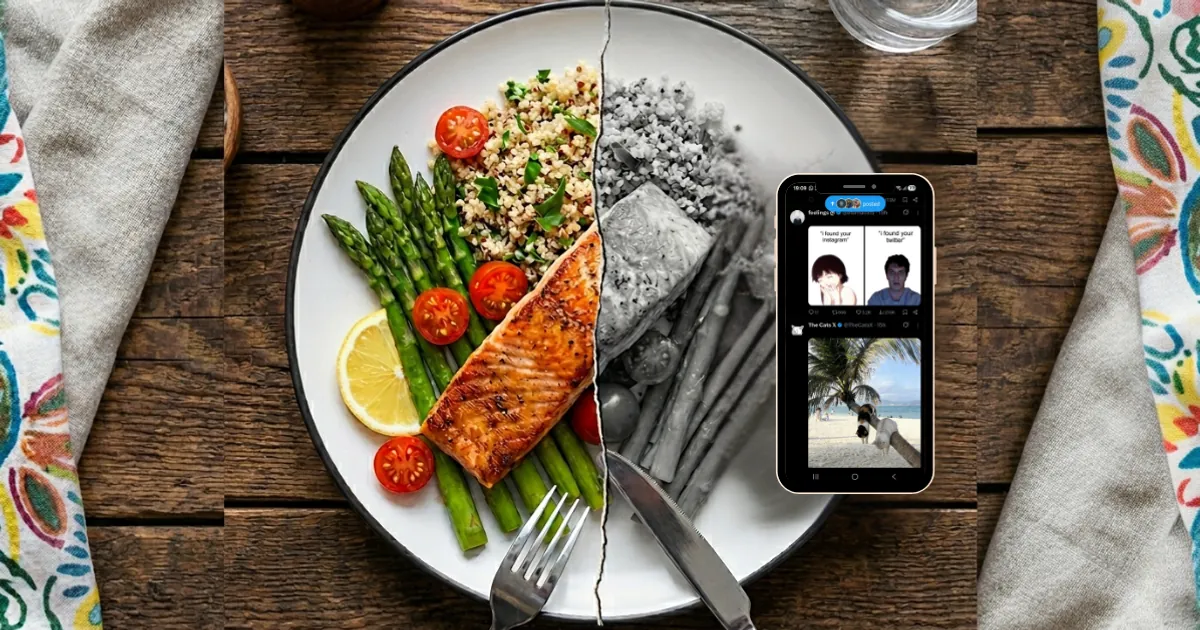
Picture the scene. You made food, or ordered it, or grabbed something between meetings. You sit down. You open your phone. You open an app. You start eating.
Twenty minutes later the plate is empty. Your thumb is still moving. You barely remember tasting anything.
If you are between 18 and 35, this is probably not an occasional thing. This is just what eating looks like now. Breakfast with Instagram. Lunch with YouTube. Dinner with TikTok. The meal and the scroll have become one ritual, so fused together that eating without a screen feels oddly wrong, like something is missing.
Here is what is actually missing: your attention. And its absence is doing more damage than you probably realize, to your digestion, your hunger signals, your relationship with food, and the quality of the time you spend on your phone.
What Happens in Your Brain When You Eat and Scroll at the Same Time
Your brain cannot genuinely multitask. What it does instead is rapidly switch attention between two things, eating and processing content, creating the illusion of doing both simultaneously.
For eating specifically, this matters more than it does for most dual-task situations. The experience of a meal is not just taste. It is a full sensory picture: smell, texture, temperature, the physical act of chewing, the gradual sensation of your stomach filling. Your brain processes all of this together to register that you have eaten and to build the satisfaction signal that tells you the meal is complete.
When your attention is primarily on your screen, that sensory picture gets fragmented. The food goes in but the experience of eating is only partially registered. Your body consumed the calories. Your brain did not fully log the meal.
The result is that familiar feeling of finishing food and still wanting something. Not hungry, exactly. Just not satisfied. That gap between full and satisfied is where the second helping lives, where the post-dinner snacking lives, where the re-opening of a delivery app twenty minutes after eating lives.
The Distracted Eating and Overeating Link Is Very Real
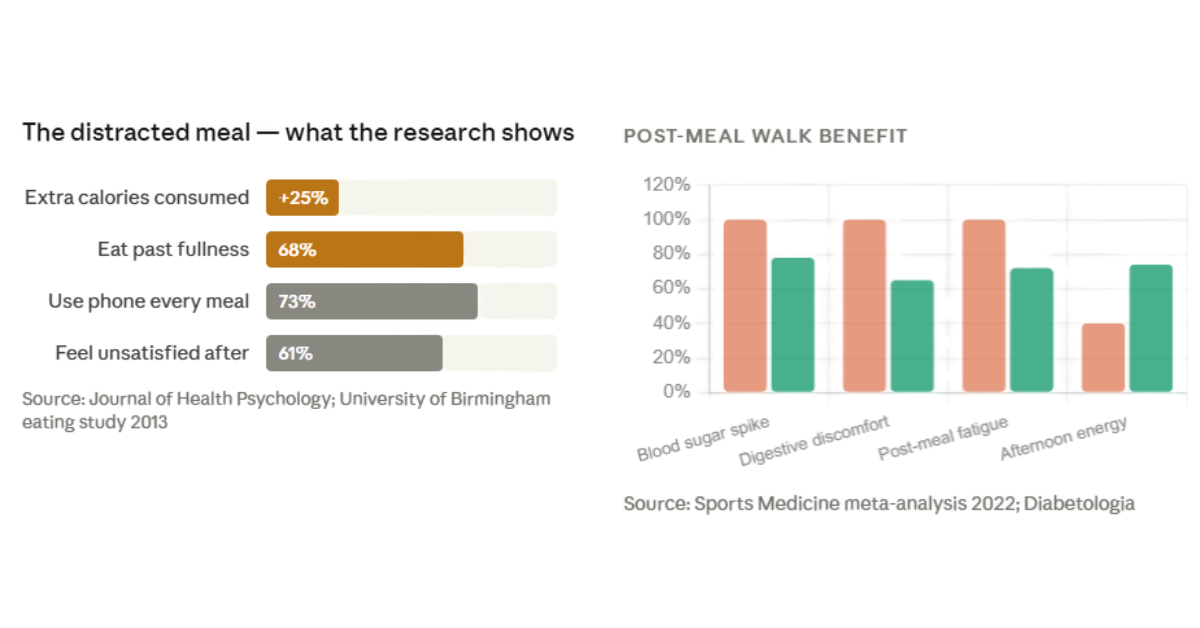
This is not an anecdote. Research on distracted eating consistently shows that people who eat while distracted consume significantly more per meal, often 10 to 25 percent more, compared to people who eat with full attention. Over days and weeks, that compounds quietly in the background.
What is also well-established is that distracted eating weakens your memory of having eaten. People who ate while scrolling or watching content reported feeling less full and less satisfied than people who ate without distraction, even when the meals were identical. Some research shows they were more likely to eat more at their next meal as well, because the brain's record of the previous meal was incomplete.
You are not eating more because you are greedy or undisciplined. You are eating more because your brain was somewhere else while your body was at the table.
The Content You Scroll Affects Your Digestion. Literally.
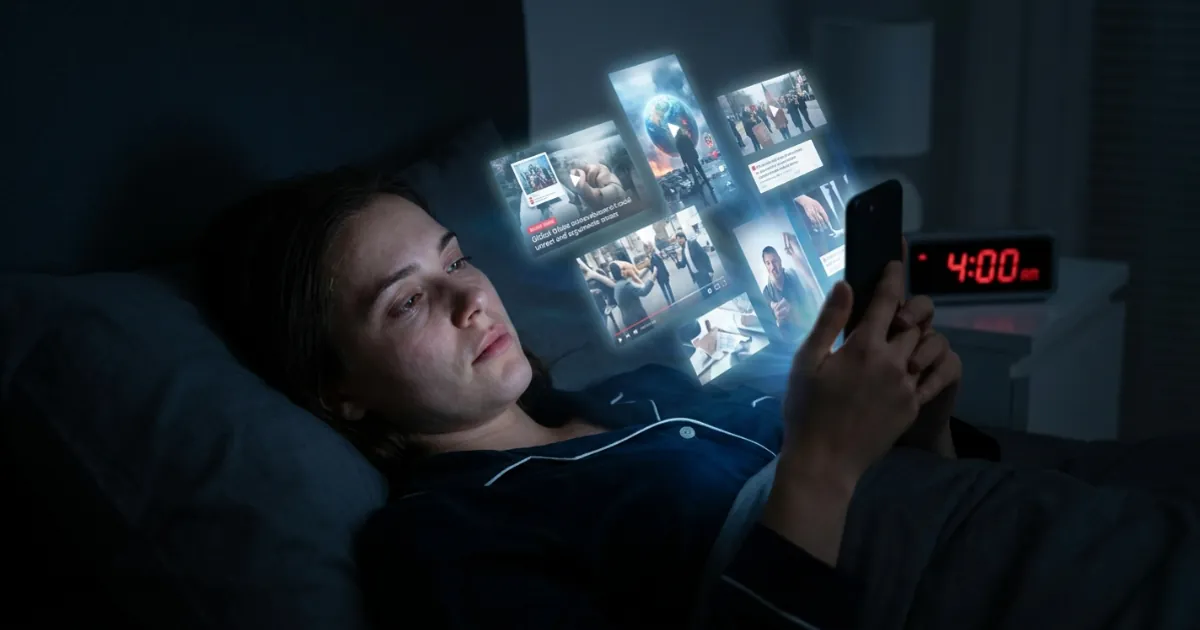
If you doomscroll during meals, which for most people is the default since anxiety-triggering content is algorithmically prioritized, you are pairing the process of digestion with active stress activation.
Distressing content triggers cortisol release. Cortisol is your body's primary stress hormone. In a stress state, your body diverts resources away from digestion and toward fight-or-flight readiness. Blood flow moves away from your gut. Digestive enzyme production slows. Gut motility changes.
You are essentially asking your digestive system to do its most important work while your brain is signaling an emergency. For anyone who already deals with bloating, IBS, acid reflux, or general digestive sensitivity, eating while scrolling through stressful content can make symptoms measurably worse.
Your gut and your brain are in constant direct communication through the vagus nerve. What you feel in your mind, your body feels in your stomach. This is not a metaphor. It is anatomy.
And Then You Sit There. For Hours.
Here is where the problem compounds. You finish eating. The scroll is already open. So you stay where you are. The meal bleeds into a scrolling session that bleeds into the next hour. You are sitting, you are digesting, and you are pumping your nervous system with whatever the algorithm decided to show you next.
This is physiologically the worst possible thing you can do after a meal.
After eating, your blood glucose rises. Your body needs to manage that rise, and one of the most effective ways it does that is movement. Even light movement, a walk around the block, a ten-minute stroll, activates muscle glucose uptake in a way that meaningfully reduces the post-meal blood sugar spike. Research on post-meal walking consistently shows it improves glycemic response, supports digestion by stimulating gut motility, and reduces the sluggish, heavy feeling that often follows a big meal.
The old advice to take a walk after eating is not folk wisdom. It is physiology. Your body is literally designed to move after it eats, not to scroll horizontally on a couch while your glucose spikes and your gut tries to quietly manage a backlog.
The sitting-and-scrolling combination after meals is one of the most common, most normalized, and most physically counterproductive habits of the current generation of young adults. And almost nobody talks about it because it does not feel like a problem. It feels like relaxing.
What If the Walk Unlocked the Scroll?
This is where things get interesting. Most advice around phone use and eating habits asks you to simply do less. Scroll less. Eat more mindfully. Spend less time on your phone. Put it away during meals. This advice is not wrong, but it treats willpower as the solution, and willpower is a finite, unreliable resource, especially after a day of decisions, stress, and mental fatigue.
What works better, behaviorally, is restructuring the sequence rather than trying to eliminate the behavior entirely.
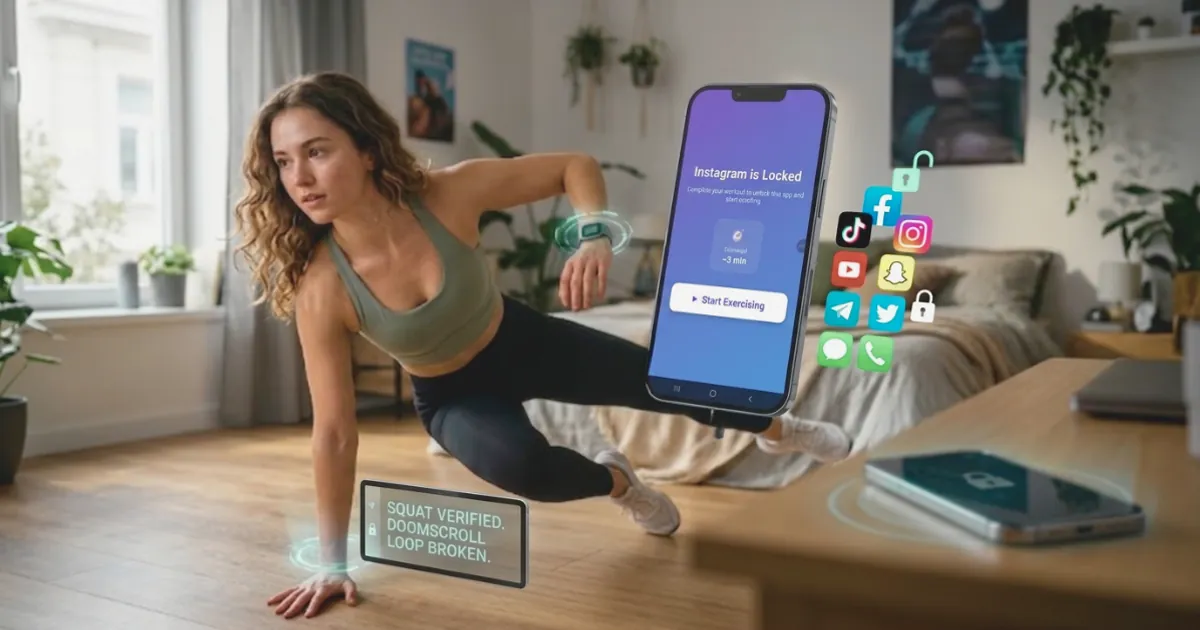
ScrollToll works on exactly this principle. Instead of blocking your social apps and leaving you with nothing, it asks you to move first. The apps unlock after exercise. Walk for ten minutes after your meal, and your feed opens. The scroll becomes something you earn through a behavior that is genuinely good for you, rather than something that just happens automatically before you have even decided to let it.
The mechanic reframes the entire post-meal window. Instead of: eat, scroll, sit, feel vaguely bad, the sequence becomes: eat, walk, open your phone having actually done something for your body. The scroll feels different when it follows movement. You are more alert, less sluggish, less prone to the passive anxious consumption that defines doomscrolling. You are choosing to engage rather than defaulting into it.
Several ScrollToll users have described the post-meal walk as the first place they noticed the app genuinely changing their routine. Not because the app forced them to walk, but because having a concrete, rewarding reason to get up after eating made the walk feel like the beginning of something rather than an interruption. One user put it simply: "I started looking forward to it. The walk became the reset, and the scroll afterward felt like a reward I actually wanted." That is a very different relationship with your phone than the one most people currently have.
"Okay But I Only Have 30 Minutes for Lunch"
Fair. The walk does not have to be long. The research on post-meal walking shows meaningful physiological benefit from walks as short as 10 minutes. A ten-minute walk after lunch, a ten-minute walk after dinner. That is the bar. It is genuinely low, and the return on it, better digestion, improved blood sugar regulation, a calmer nervous system, and an actual transition out of the meal rather than a bleed into sedentary scrolling, is genuinely high.
The walk also serves a function that has nothing to do with steps or calories. It creates a boundary. Meals become their own contained experience rather than a precursor to a scrolling session that could last an hour. You eat. You close the chapter. You move. Then you open your phone as a deliberate choice rather than a continuation of a half-conscious habit.
Boundaries around mealtime are one of the most consistently recommended practices in both nutritional psychology and digital wellbeing research. They are difficult to maintain through willpower alone. They are significantly easier to maintain when a tool reinforces the structure for you.
The Bigger Picture
The eating-scrolling-sitting loop is not just a bad habit. It is a behavioral pattern that compounds quietly over time, eroding your relationship with food, weakening your body awareness, disrupting your digestion, and locking you into a passive, anxious relationship with your phone.
The people who break out of it are not the ones who successfully white-knuckled their way through enough "put your phone down" resolutions. They are the ones who changed the structure of the behavior so that a better choice became the easier choice.
Eating with your full attention. Walking after your meal. Opening your phone as a reward for having moved your body. None of this is complicated. None of it requires you to become a different person or adopt a lifestyle that does not fit who you are.
It just requires a slightly different sequence. And sometimes, the right tool to enforce that sequence.
Your digestion works better when you move. Your brain registers food better when you are present. Your relationship with your phone gets healthier when the scroll follows intention rather than habit.
Eat. Walk. Then scroll. It is a small change. It turns out to be a significant one.
Evidence & References
Ready to break the loop?
Download ScrollToll and start earning your screen time through real movement.