New peer-reviewed research confirms what your body has been telling you: smartphone addiction and physical inactivity are locked in a reinforcing loop — one that reshapes your dopamine system, damages your posture, and shrinks your attention span. Here is the science, and how exercise breaks the cycle at the neurological level.
There is a question most people have not asked themselves: Why, exactly, does picking up your phone also mean sitting down?
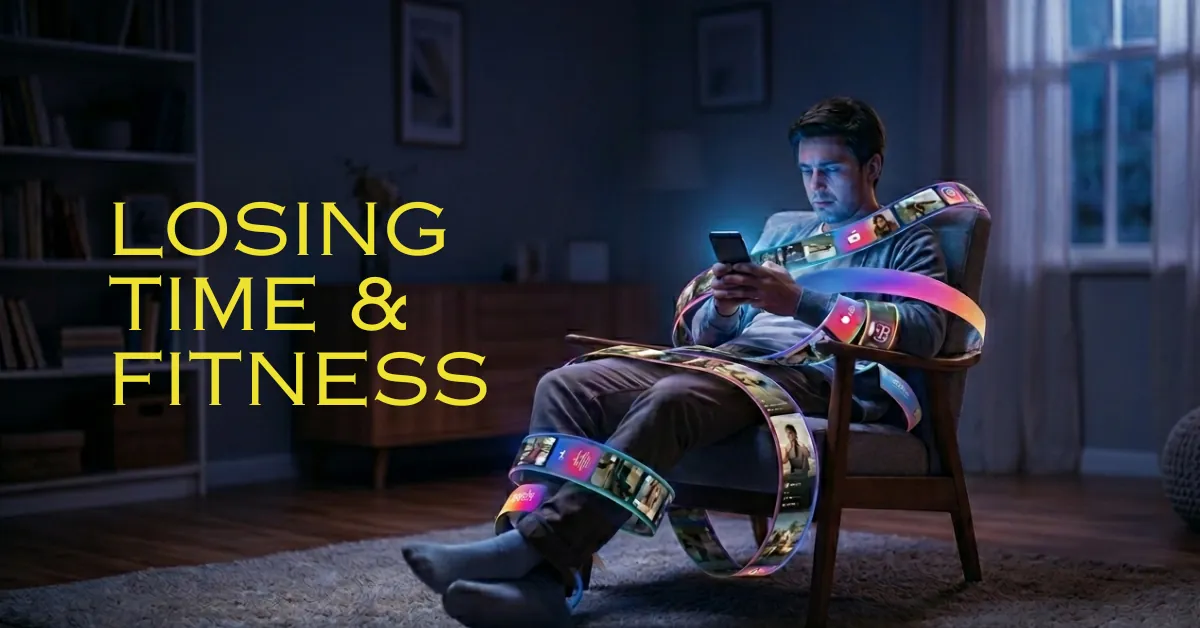
It is so automatic we do not notice it anymore. You feel the pull of your phone — and your body goes still. You settle into the couch. You stop moving. You stop everything that is not scrolling.
This is not a coincidence, and it is not a willpower problem. It is a neurological loop that modern research is only now fully mapping — and the findings are, frankly, alarming. More importantly, the same research reveals something that phone-based screen time interventions consistently miss: the most powerful antidote to smartphone addiction is not a timer. It is movement.
The Numbers Nobody Wants to Face
These numbers describe a population that is not just distracted — it is physically inert for a large portion of its waking life. And the relationship between screen time and sedentary behavior is not merely correlational. A 2025 meta-analysis published in the Journal of Psychiatric Research confirmed a statistically significant association between smartphone addiction and sedentary behavior across children, adolescents, and young adults — one that holds across cultures and age groups.
The Feedback Loop Your Phone Wants You to Stay In
To understand why this loop is so hard to break, you need to understand what your phone is actually doing to your brain’s reward system.
Social media platforms are not accidentally addictive. They were built with the explicit input of behavioral scientists and neuroscientists whose job was to identify and exploit the brain’s dopamine response. The result is a product that delivers variable rewards — the same psychological mechanism behind slot machines. Every scroll might deliver something rewarding, or it might not. That unpredictability is precisely what keeps the dopamine system locked in.
Watch the full discussion on YouTube — Huberman Lab (2024), with psychologist Dr. Jonathan Haidt and neuroscientist Dr. Andrew Huberman breaking down the dopamine mechanics of smartphone addiction and what evidence-backed interventions actually work: youtube.com/watch
What the research now confirms is that this dopamine loop does not just affect your mood — it physically rewires the circuits in your brain over time. Neurobiological studies show that excessive smartphone use alters dopamine signaling in the mesolimbic and nigrostriatal pathways — the same circuits implicated in substance addiction. The brain becomes less responsive to everyday rewards. Ordinary activities — including exercise, social interaction, and sustained work — become harder to motivate because they cannot compete with the phone’s engineered stimulation threshold.
What Sitting Still Is Doing to Your Body
The sedentary dimension of smartphone addiction is under-discussed in digital wellness content. We talk about attention spans, anxiety, and sleep. We rarely talk about what compulsive phone use is physically doing to the human body.
- Posture & Spine: A 2025 narrative review in Applied Sciences found smartphone use causes forward head posture, altered spinal curves, and measurable gait changes — collectively now called "tech neck."
- Joints & Tendons: Smartphone addiction is positively associated with repetitive joint overuse, leading to inflammatory changes, carpal tunnel syndrome, and chronic wrist and thumb pain in young adults.
- Cardiovascular Risk: Sedentary time exceeding 10 hours daily significantly raises cardiovascular disease risk, independent of any exercise done during the day — per a major dose-response meta-analysis.
- Metabolic Health: Adults with excessive screen exposure show higher rates of obesity and lower physical fitness, partly through inactivity and the disrupted sleep patterns that follow late-night scrolling.
- Cognitive Function: Excessive short-form video consumption is linked to attentional deficits, impaired executive control, and working memory problems — the brain literally becomes less capable of sustained focus.
- Sleep Architecture: Blue light suppresses melatonin by up to 60 minutes. But the bigger problem is psychological: doomscrolling before bed elevates cortisol at the exact moment your brain needs to deactivate.
The Research Intervention Nobody Talks About: Exercise
Here is where the science gets genuinely surprising — and where most "digital detox" content completely misses the point.
The dominant narrative around reducing screen time focuses on restriction: timers, app limits, notification settings, phone-free periods. These tools have value. But a growing body of peer-reviewed research suggests that the single most powerful behavioral intervention for smartphone addiction is not restriction at all. It is structured physical exercise.
Physical Activity and Smartphone Addiction in University Students: A Systematic Review (2025). Published in Preventive Medicine Reports (Pirwani & Szabo, ELTE Eötvös Loránd University), this PRISMA-compliant review synthesized 16 studies from January 2024 to March 2025. Finding: all studies found an inverse relationship between physical activity and smartphone addiction. Experimental and longitudinal studies specifically showed that structured exercise reduces addiction symptoms over time — not just correlation, but causal reduction. Read the study: ncbi.nlm.nih.gov/pmc
Physical Activity and Mobile Phone Addiction: Systematic Review & Meta-Analysis (MDPI Behavioral Sciences, 2025). This meta-analysis confirmed neurobiological mechanisms: physical activity alters dopamine circuits in the mesolimbic and nigrostriatal pathways, increases hippocampal volume, promotes prefrontal cortex growth, and enhances self-control — all of which directly reduce compulsive phone use. The authors found that self-control fully mediates the relationship between regular exercise and reduced smartphone addiction. Read the study: mdpi.com/2076-328X
Positive Exercise Experience and Mobile Phone Addiction: Cross-Lagged Panel Study (Frontiers in Public Health, 2025). A three-wave longitudinal study across 828 participants over 9 months (April 2024 – January 2025) found that positive exercise experience functions as both a preventive and corrective strategy against smartphone addiction. Exercise satisfies the same psychological needs that smartphones hijack — belonging, competence, and engagement — making the phone less necessary as a fulfillment mechanism. Read the study: ncbi.nlm.nih.gov/pmc
Why Timers and App Limits Don’t Work Alone
Understanding why timers fail requires understanding the nature of compulsive behavior. Smartphone addiction is not a habit in the ordinary sense — it is a behavior driven by altered neurochemistry. You are not just "choosing" to scroll. You are responding to a dopamine deficit that the phone created, seeking relief from a state of low arousal that the phone trained your brain to experience between sessions.
App timers address the output of this system — they put a cap on the behavior. But they leave the underlying neurochemical state unchanged. This is why it feels so easy to hit "ignore" when your screen time limit appears. Your prefrontal cortex — the seat of impulse control and long-term decision making — is already compromised by the dopamine deficit, and it does not have the resources to override the craving.
Exercise addresses the input. It restores dopamine baseline. It physically rebuilds prefrontal cortex tissue and connectivity. It provides the neurological raw material for self-control that no timer can manufacture.
The "Earn Your Screen Time" Model — What the Science Supports
If exercise is the intervention, the challenge becomes behavioral design: how do you consistently get someone who is addicted to their phone to exercise before they use it?
The answer emerging from behavioral research is friction plus reward. Creating a meaningful behavioral barrier between the urge to scroll and the act of scrolling — one that is also immediately rewarding — disrupts the automatic nature of the habit. Apps that require physical exercise to unlock screen time do precisely this. They create a moment of agency in what is otherwise a reflex. They make the body move before the mind gets its reward. And in doing so, they use the reward system itself to repair the reward system.
This is the core mechanism behind ScrollToll. You do not get screen time on Instagram, TikTok, or YouTube until you have completed real, AI-tracked exercise — squats, push-ups, jumping jacks, or any of the supported movements. The screen is locked until the body has moved. The app uses your phone’s camera to verify the reps. There is no bypass.
Breaking the Loop: What the Research Recommends
Based on the studies cited in this article, here is what actually works — in order of evidence strength:
- Use physical exercise as the "price" of screen time. This directly addresses dopamine dysregulation, not just behavior. Even 5–10 minutes of movement before accessing distracting apps changes the neurological context of use.
- Make friction proportional to risk. Not all apps are equal — your messaging app is not the same as TikTok. Reserve exercise requirements for the apps most engineered for compulsive use.
- Protect sleep with hard blocks. Schedule phone lockouts after 10pm. This single intervention improves sleep onset, cortisol regulation, and next-day cognitive performance. No timer bypass allowed.
- Design for the automatic brain, not the rational one. Willpower is a finite, depletable resource. The best digital wellness tools work even when your willpower is at zero — because the barrier is physical, not cognitive.
- Track movement, not just screen time. Most screen time tools show you what you lost. The goal is to show you what you gained — fitness streaks, calories, workout history. Positive framing outperforms punishment in long-term behavior change.
Try ScrollToll free: getscrolltoll.app
Questions People Actually Ask
Does exercise actually reduce smartphone addiction — or is this just correlation?
The evidence has moved well beyond correlation. A 2025 PRISMA systematic review (Pirwani & Szabo) covering 16 studies found that experimental and longitudinal designs — which can establish causality — specifically show exercise reduces addiction symptoms over time. A parallel meta-analysis confirmed the neurobiological mechanism: exercise physically alters dopamine circuits in the mesolimbic pathway, increases hippocampal volume, and promotes prefrontal cortex growth. These are structural brain changes, not attitudinal ones.
How much exercise do I need to see an effect on screen time habits?
The longitudinal studies do not prescribe a specific dose, but consistent, structured activity is the key phrase — even brief daily sessions outperform sporadic longer ones. The goal is not fitness per se; it is neurological regulation. Short exercise sessions before accessing distracting apps (the ScrollToll model) appear to create enough dopaminergic shift to reduce the intensity of the craving. Think 5–15 minutes per session, consistently, rather than one-hour workouts twice a week.
What does "tech neck" actually do to the body long-term?
A 2025 narrative review in Applied Sciences (Lee & Son) documented that smartphone use causes forward head posture, altered spinal alignment, and gait changes observable in young adults. The forward head position adds roughly 10 pounds of effective force on the cervical spine per inch of forward displacement — a person texting with their head at a 60-degree angle is placing the equivalent of 60 pounds of pressure on their neck. Over years, this contributes to early-onset disc degeneration, chronic pain, and postural compensation patterns throughout the entire kinetic chain.
Is it enough to just set app limits in my phone settings?
Built-in screen time tools are easy to bypass because they rely on the same prefrontal cortex function that smartphone overuse has already compromised. When the urge to scroll peaks, your capacity for self-override is at its lowest — which is exactly when the "ignore for today" button gets pressed. Effective interventions create barriers that work independently of willpower: physical requirements (like completing exercise), hard schedule locks, or structural phone separation (leaving it in another room). The research consistently shows that environmental design outperforms motivation-based approaches for compulsive behaviors.
What is ScrollToll and how does it work?
ScrollToll is a digital wellness app that blocks distracting apps (Instagram, TikTok, YouTube, etc.) and only unlocks them after you complete verified physical exercise — squats, push-ups, jumping jacks, and other movements tracked by AI pose detection via your phone’s camera. The model is based on the research-backed principle that exercise builds the neurological infrastructure for self-control and raises dopamine baseline, making the phone feel less urgently necessary. It is available on both iOS and Android, free to try.
References & Sources
- Pirwani, N. & Szabo, A. (2025). One-year update on physical activity and smartphone addiction in university students: A systematic review. Preventive Medicine Reports. PMC12304691.
- MDPI Behavioral Sciences (2025). The Relationship Between Physical Activity and Mobile Phone Addiction in College Students: A Systematic Review and Meta-Analysis.
- Chen, B., Huang, W., Hu, C. (2025). Positive exercise experience and mobile phone addiction tendencies in older adults: a cross-lagged study. Frontiers in Public Health. PMC12661996.
- Zhu, W. et al. (2025). Smartphone dependence and its influence on physical and mental health. Frontiers in Psychiatry.
- Lee, I.G. & Son, S.J. (2025). Effects of Smartphone Use on Posture and Gait: A Narrative Review. Applied Sciences, 15(12), 6770.
- Journal of Psychiatric Research, Volume 184 (2025). Association between smartphone addiction and sedentary behaviour: Systematic review and meta-analysis.
- Huberman, A. & Haidt, J. (2024). How Smartphones & Social Media Impact Mental Health & the Realistic Solutions. Huberman Lab Podcast.
- Autonomous.ai (2025). Average Screen Time For Adults Per Day In 2025.
Ready to break the loop?
Download ScrollToll and start earning your screen time through real movement.