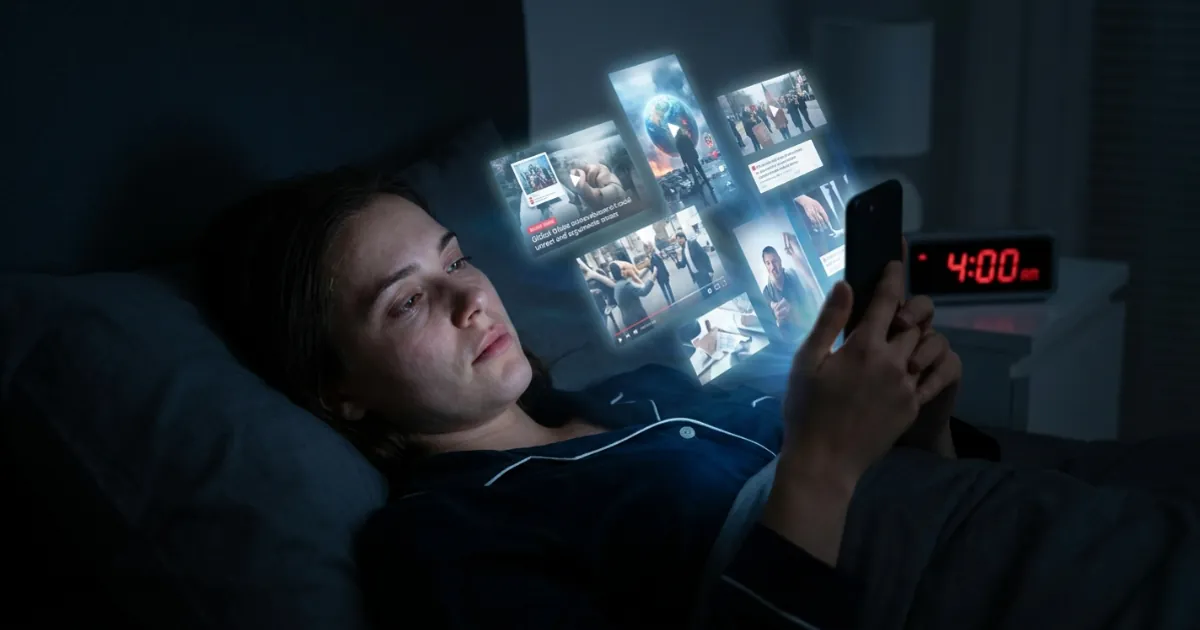
Doomscrolling is fueling anxiety, depression, and burnout. Learn how compulsive social media scrolling affects your mental health and discover practical ways to stop doomscrolling for good.
If you have ever picked up your phone to check a notification and looked up 45 minutes later feeling worse than before, you already know what doomscrolling feels like. You did not intend to spend that time reading bad news, watching distressing videos, or spiraling through anxiety-inducing threads. It just happened. Again.
Doomscrolling is one of the most underestimated mental health threats of the digital age. And it is getting worse.
What Is Doomscrolling?
Doomscrolling (also written as doom scrolling or doom-scrolling) is the compulsive habit of continuously scrolling through negative, distressing, or overwhelming content online, even when that content causes stress, anxiety, or sadness.
It typically happens on social media platforms like Instagram, X (formerly Twitter), TikTok, Reddit, and Facebook, as well as news apps and video platforms. The content does not have to be world-ending news to count as doomscrolling. Anything that triggers a cycle of anxious, compulsive consumption qualifies.
Common doomscrolling triggers include: breaking news and global crises, political conflict and social unrest, negative comment sections and online arguments, health scares and medical misinformation, financial anxiety content, and comparison-driven social media feeds.
The Mental Health Effects of Doomscrolling
Researchers and mental health professionals have spent years studying the relationship between screen time, social media use, and psychological wellbeing. The findings are consistent and concerning.
1. Doomscrolling Increases Anxiety
Every piece of distressing content you consume activates your brain's threat-detection system. Your amygdala, the part of the brain responsible for processing fear, does not distinguish between a real physical threat and a news headline about a disaster on the other side of the world.
When you doomscroll, you are feeding your brain a continuous stream of perceived threats. This keeps your nervous system in a low-grade state of fight-or-flight activation. Over time, chronic anxiety, hypervigilance, and a persistent sense of dread become your baseline.
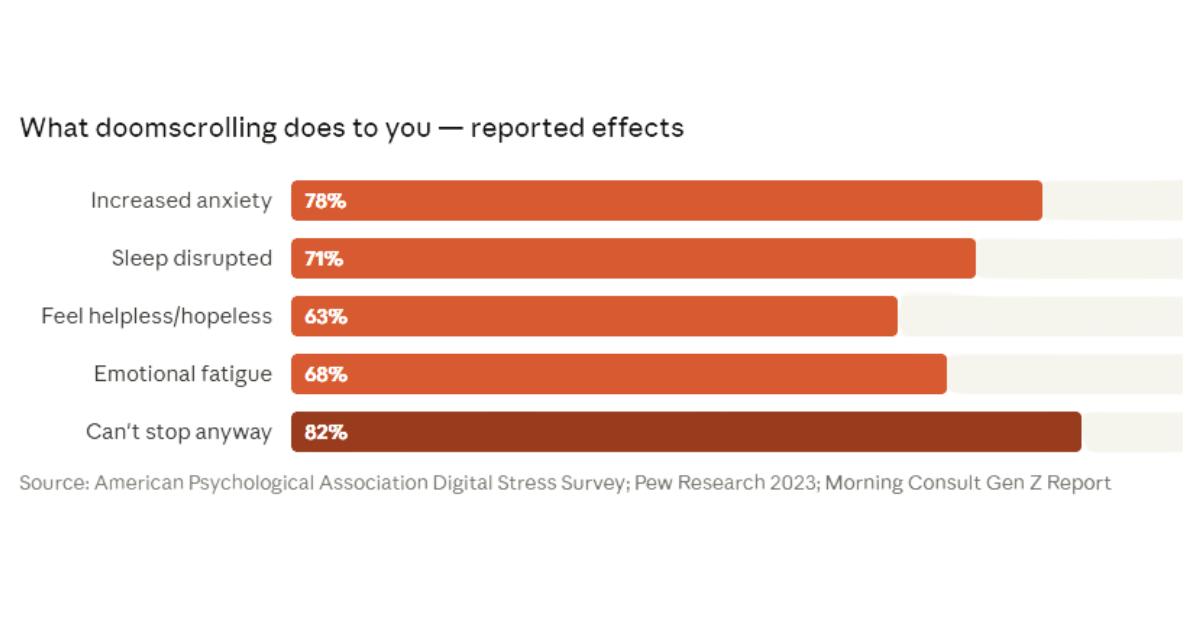
Studies on social media use and anxiety consistently show that higher consumption of negative online content correlates directly with elevated anxiety symptoms. If you struggle with generalized anxiety disorder (GAD) or social anxiety, doomscrolling can dramatically worsen your symptoms.
2. Doomscrolling Worsens Depression
Doomscrolling and depression have a well-documented relationship. Passive social media consumption, which is scrolling without actively engaging or connecting, is linked to increased feelings of hopelessness, worthlessness, and emotional numbness.
The comparison trap makes this worse. Seeing curated highlights of other people's lives while consuming negative news creates a disorienting mix of inadequacy and helplessness. Your brain starts to believe that the world is terrible and that you, personally, are not doing enough or being enough.
This is a known cognitive distortion pattern called catastrophizing, and doomscrolling feeds it directly.
3. Doomscrolling Disrupts Sleep
Nighttime doomscrolling is particularly destructive. The blue light emitted by phone screens suppresses melatonin production, making it harder to fall asleep. But the bigger problem is psychological.
Reading upsetting content before bed activates your stress response, raising cortisol levels at the exact moment your body needs to wind down. Many people report lying awake after late-night scrolling sessions, replaying distressing content in their minds and unable to quiet anxious thoughts.
Poor sleep then feeds directly back into anxiety and depression, creating a feedback loop that is genuinely hard to break without intervention.
4. Doomscrolling Contributes to Burnout and Emotional Fatigue
Information overload is a real psychological phenomenon. When your brain is constantly processing high-volume, high-stakes content, it depletes your cognitive and emotional resources. This is called compassion fatigue or emotional burnout, and it is increasingly common among heavy social media users.
Symptoms include feeling emotionally numb, having difficulty concentrating, losing interest in things you used to enjoy, and feeling a vague but persistent sense that everything is too much. Doomscrolling accelerates this process because it combines high content volume with high emotional intensity.
5. Doomscrolling Creates a Compulsive Loop
One of the most insidious aspects of doomscrolling is that it feels impossible to stop, even when you are aware it is harming you. This is not a willpower failure. It is neuroscience.
Social media platforms are built using variable reward mechanics, the same psychological principle behind slot machines. Every scroll has the potential to deliver something interesting, validating, or emotionally triggering. That unpredictability keeps your dopamine system engaged, compelling you to keep going even when you feel bad.
This is what makes doomscrolling a compulsive behavior rather than a simple habit. The brain's reward circuitry gets hijacked, and stopping requires more than just deciding to put the phone down.
Who Is Most Vulnerable to Doomscrolling?
While anyone with a smartphone can fall into doomscrolling patterns, certain groups face higher risk: people with anxiety disorders are more sensitive to threat-related content and more likely to seek information as a coping mechanism; people with depression may use scrolling as emotional numbing; highly empathetic individuals absorb the distress in content they consume; teens and young adults whose brains are still developing impulse control; and people experiencing major life stress such as job loss, relationship difficulties, or health challenges.
How to Stop Doomscrolling: Practical Strategies That Actually Work
The good news is that doomscrolling is a behavioral pattern, and behavioral patterns can be changed. Here are evidence-backed strategies for reducing compulsive scrolling and protecting your mental health.
Set Screen Time Limits (And Enforce Them)
Most smartphones have built-in screen time tools, but they are easy to bypass with a tap. Dedicated apps that stop you from doomscrolling enforce limits with actual friction, making it harder to override your intention to stop.
Look for apps that allow you to set hard daily limits on specific apps, schedule phone-free periods, and block access to high-trigger platforms during vulnerable times like late at night or first thing in the morning.
Use a Doomscrolling Blocker App
A purpose-built app to stop doomscrolling goes further than basic screen time controls. The best doomscrolling apps combine usage tracking, behavioral nudges, and real-time intervention. When you start compulsively scrolling, the app interrupts the loop and redirects you.
This kind of tool works because it addresses the automatic, habitual nature of doomscrolling rather than relying on willpower alone. Willpower is a finite resource. Smart technology that acts as a circuit breaker is more effective.
Create Phone-Free Zones and Times
Designate your bedroom as a phone-free space. Keep your phone out of reach at meals. Build a morning routine that does not begin with checking your phone. These physical and temporal boundaries reduce the number of opportunities for doomscrolling to start.
Research on behavior change consistently shows that environmental design, changing your physical context, is more powerful than motivation or intention alone.
Replace the Scroll With a Competing Behavior
The urge to scroll does not disappear when you take away the phone. You need to replace the behavior with something that meets the same underlying need.
If you scroll when you are bored, keep a book or a puzzle nearby. If you scroll when you are anxious, try a breathing exercise or a short walk. If you scroll for connection, text a friend directly instead. Substitution works better than suppression.
Curate Your Feed Intentionally
Not all social media use is harmful. The problem is passive, unintentional consumption of negative content. Take time to unfollow accounts that consistently make you feel worse. Mute keywords and topics that trigger anxiety spirals. Follow creators whose content leaves you feeling informed, inspired, or genuinely connected.
This does not eliminate doomscrolling risk entirely, but it changes the landscape so that a scroll session is less likely to spiral.
Talk to a Mental Health Professional
If doomscrolling is significantly affecting your mood, sleep, relationships, or productivity, it is worth speaking with a therapist or counselor. Cognitive behavioral therapy (CBT) is particularly effective for compulsive behaviors and the anxiety patterns that drive them.
You do not need to be in crisis to benefit from professional support. Many people find that even a few sessions help them understand the emotional needs driving their scrolling habits and develop healthier ways to meet those needs.
The Bottom Line
Doomscrolling is not a character flaw or a sign of weakness. It is a predictable human response to the way modern technology is designed combined with the genuine uncertainty and anxiety of the world we live in.
But understanding why doomscrolling happens does not mean you have to accept its mental health consequences. Chronic anxiety, worsening depression, disrupted sleep, and emotional burnout are not inevitable. They are the result of a habit that can be interrupted, redirected, and replaced.
The first step is recognizing the pattern. The next step is using the right tools to change it.
If you are ready to take back control of your screen time and protect your mental health, a dedicated app to stop doomscrolling like ScrollToll can make all the difference. Because sometimes, the most powerful thing you can do for your wellbeing is simply put the phone down.
Evidence & References
Ready to break the loop?
Download ScrollToll and start earning your screen time through real movement.