Which countries ban social media for teens? Australia's under-16 law, the EU KIDS Act, and every country planning age limits, and what families can do now.
Quick answer: As of October 2026, Australia is the first country with a full social media ban for under-16s in force, since December 10, 2025. Malaysia and Indonesia have introduced similar age limits of 16. The European Union proposed the EU KIDS Act on September 17, 2026, which would bar under-13s from social media accounts and limit 13 and 14-year-olds to parent-supervised accounts with a one-hour daily cap. Denmark, France and Greece are moving toward an age limit of 15, and Spain, Norway, the UK and New Zealand are considering 16. In the United States, several states have passed their own laws, but there is no national ban.
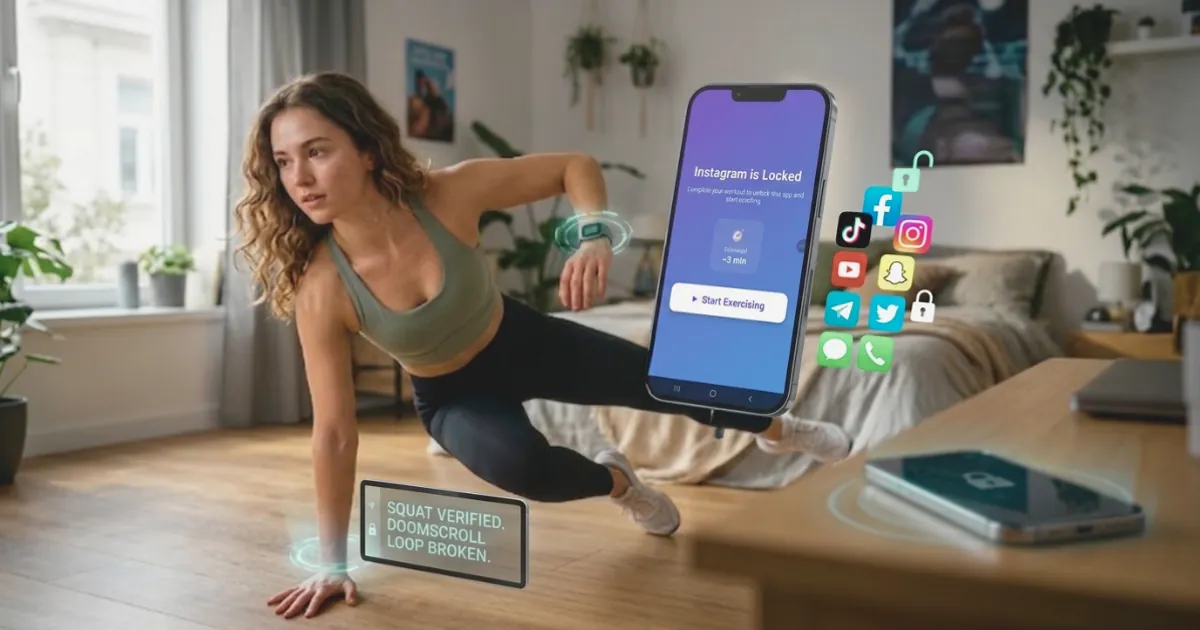
These laws all aim at the same problem: apps designed to keep young people scrolling. Whether or not your country passes one, the habits they target can be changed at home, and tools like ScrollToll: Screen-Time Gym help by locking the most addictive apps until you move.
Social media age limits by country (October 2026)
These measures are not all the same. Some ban accounts outright, some require parental consent, and some only restrict certain features. Several are still proposals.
| Country or region | Age limit | Status | What it covers |
|---|---|---|---|
| Australia | 16 | In force since December 10, 2025 | Platforms must stop under-16s holding accounts on Facebook, Instagram, Snapchat, Threads, TikTok, Twitch, X, YouTube, Reddit and Kick |
| Malaysia | 16 | Introduced in 2026 | Under-16s barred from opening accounts; platforms must add child-safety safeguards |
| Indonesia | 16 for high-risk services | Introduced | Platforms must sort services by risk and use stronger age checks |
| European Union | Under 13: no accounts; 13 to 14: supervised; 15+: own account | Proposed September 17, 2026 (EU KIDS Act) | Certified age checks, one-hour daily limit for 13 and 14-year-olds, limits on infinite scroll, autoplay and streaks |
| Denmark | 15 | Planned | Parents could allow some platforms from age 13 |
| France | 15 | Legislation moving through parliament | Backed by President Macron, who also pushes for EU-wide rules |
| Greece | 15 | Planned | Focus on real age checks instead of self-declared ages |
| Spain | 16 | Proposed | Would require effective age verification |
| Norway | 16 | Proposed | Exceptions expected for school and organised activities |
| United Kingdom | 16 | Under review | Builds on the Online Safety Act |
| New Zealand | 16 | Bill proposed | Platforms responsible; messaging and gaming may be excluded |
| Austria | 14 | Proposed | Algorithm-driven platforms such as TikTok, Instagram, YouTube and Snapchat |
| Turkey | 15 | Introduced or planned | Account limits plus stronger age checks and parental controls |
| Portugal | Parental consent from 13 to 16 | Progressing | Explicit parental consent, possibly checked with digital ID |
| Brazil | No fixed age | In force | Stronger age checks, parental oversight and limits on profiling and targeted ads for minors |
| United States | Varies by state | Patchwork | Several states require parental consent or ban younger teens; many laws face court challenges |
Source: Cyprus Mail roundup, September 17, 2026, European Commission and eSafety Commissioner. Laws change fast, so check each country's latest status before relying on it.
Australia: the first full ban for under-16s
Australia's law took effect on December 10, 2025. It puts the responsibility on the platforms, not on children or parents. Companies must take "reasonable steps" to stop under-16s from creating or keeping accounts, and they face fines of up to A$49.5 million for serious or repeated breaches.
What happened next:
- 4.7 million accounts: Within weeks of the law starting, platforms had removed about 4.7 million accounts held by under-16s, according to Australia's eSafety Commissioner, as reported by Euronews.
- Meta alone removed over 750,000: By June 30, 2026, Meta said it had removed access to more than 750,000 Facebook and Instagram accounts it believed belonged to under-16s in Australia, according to Meta's own update.
- Not airtight: The regulator has acknowledged that some under-16s still have active accounts, and that some kids "may find creative ways to stay on social media."
- What is not covered: Messaging apps and gaming are excluded, so a teen can still use those.
Meta has argued that age should be checked once, at the phone or app store level, instead of separately in every app. That debate is now shaping laws in other countries.
Europe: the EU KIDS Act and national bans
On September 17, 2026, the European Commission proposed the EU KIDS Act. If it becomes law, it would set one set of rules for all 27 member states:
- Under 13: No social media accounts. Parents could allow limited access to video platforms made for young children through their own account.
- 13 and 14: A parent-controlled account with parental tools always on, contacts approved by a parent, and a daily limit of one hour at most.
- 15 and older: Their own accounts, on services that must be designed to be safe for them.
The proposal also goes after the design tricks that keep people scrolling. It targets endless autoplay and infinite scrolling, notifications that pull children back, rewards for posting, and "streak" mechanics that punish missing a day. Age checks would need certified tools that tell the platform only whether a user is over or under the age, not who they are. Fines could reach 6% of a company's worldwide annual turnover, according to the Commission's explainer.
The proposal is open for feedback until December 3, 2026, and still has to be agreed by EU governments and the European Parliament. Meanwhile, several countries are moving on their own: Denmark, France and Greece toward 15, Spain and Norway toward 16, and Austria toward 14 for algorithm-driven platforms.
Asia, Oceania and the rest of the world
- Malaysia: Bars under-16s from opening social media accounts and requires platforms to meet child-safety rules.
- Indonesia: Sets 16 as the threshold for high-risk services, framed as delaying access rather than a general ban.
- New Zealand: A bill would restrict under-16s from accounts on designated platforms, following Australia's model.
- Turkey: Account limits for under-15s, with stronger age verification.
- Brazil: No fixed minimum age, but a new statute strengthens age checks, parental oversight and limits on profiling minors.
- China: Long-standing limits on minors' content, usage time and spending across games, video and social apps.
The United States: a state-by-state patchwork
There is no national social media ban for teens in the US. Instead, states have passed their own laws. Florida's law bars children under 14 from holding accounts on certain platforms and requires parental consent for 14 and 15-year-olds. Other states, including Utah, Texas, Tennessee, Georgia and Louisiana, have passed parental consent or age verification laws. Several state laws have been blocked or challenged in court on First Amendment grounds, so what is actually enforced varies and keeps changing.
Why governments are acting
The push comes from years of worry about teen mental health. According to the US Surgeon General's advisory on social media and youth mental health:
- Up to 95% of 13 to 17-year-olds use social media, and about one in three say they use it "almost constantly".
- Teens spend an average of 3.5 hours a day on social media.
- Young people who spend more than 3 hours a day on social media face double the risk of depression and anxiety symptoms.
- 46% of 13 to 17-year-olds said social media makes them feel worse about their bodies.
The common thread in the new laws is design. Infinite feeds, autoplay and streaks are built to be hard to put down, which is why the EU proposal names them directly. We wrote more about this in how doomscrolling affects your mental health.
Do social media bans work?
It is too early to say. Australia's regulator has said the full impact may take years to show. Supporters say a clear age limit takes pressure off parents, because "everyone else has it" stops being true. Critics raise three main concerns:
- Workarounds: Teens can lie about their age, borrow accounts or use VPNs, and some will.
- Privacy: Checking everyone's age means more identity checks for adults too, which is why the EU proposal insists on tools that reveal only an age range.
- Lost support: For some teens, especially those who feel isolated, online communities are a lifeline. A blanket ban cuts those off along with the harmful parts.
What most experts agree on is that a law alone is not enough. Habits at home, and the design of the apps themselves, matter just as much.
What families can do now, with or without a ban
You don't need to wait for a law. These steps work in any country:
- Know the real number: Check screen time on your family's phones together. Our ScrollToll screen time calculator turns daily hours into days per year, which makes the conversation easier.
- Delay, don't just ban: Agree on an age for each app as a family, and explain why. Teens follow rules better when they understand them.
- Use the built-in controls: iPhone Screen Time and Android's Family Link can limit apps, set downtime and approve downloads. See our guide to parental locks that actually stop doomscrolling.
- Make phones leave the bedroom: Charge them in the kitchen overnight. Late-night scrolling is the habit most linked to poor sleep.
- Add friction, not just limits: Time limits are easy to ignore. Making apps take effort to open works better. In a 2023 study in PNAS, adding a short delay before a social app opened led people to open it 57% less often after six weeks.
- Model it yourself: Kids copy what adults do. If you scroll at dinner, they will too.
It's not only teens
The laws focus on young people, but adults struggle too. In a 2026 Pew Research Center survey, 53% of US adults said they spend too much time on their phone, rising to 70% of adults under 30. The same design tricks that the EU wants to limit for children work on grown-ups as well. Our guide on how to stop phone addiction has a 4-week plan for any age.
How ScrollToll: Screen-Time Gym helps
ScrollToll: Screen-Time Gym was built for exactly the problem these laws target: apps that are too easy to open and too hard to close. It locks the apps you choose, such as TikTok and Instagram, and you earn screen time back by exercising. Your phone's camera counts every rep on the device, and nothing is recorded. Strict Mode makes changes that loosen the rules wait 24 hours, so a late-night urge can't undo them.
It turns the scroll into a choice, and gets you moving at the same time. Read more about how a screen-time gym works.
Stay up to date
These laws are changing month by month. We broke this down on LinkedIn: read the post and follow ScrollToll for updates on screen-time laws and research, and visit getscrolltoll.app for more guides.
Ready to take back your time? Download ScrollToll: Screen-Time Gym on the App Store for iPhone or Google Play for Android, and start with a 3-day trial.
Sources
- Cyprus Mail (2026). Social media age limits: what countries around the world are doing.
- European Commission. The KIDS Act explained.
- eSafety Commissioner (Australia). Social media age restrictions.
- Euronews (2026). Australia's under-16 social media ban: how is it going one month since the law took effect?
- Meta (2026). Meta's compliance with Australia's social media ban.
- US Surgeon General (2023). Social Media and Youth Mental Health advisory.
- Pew Research Center (2026). About half of Americans say they spend too much time on their smartphone.
- Grüning, D. J., et al. (2023). Directing smartphone use through the self-nudge app one sec. PNAS.
Frequently Asked Questions
Which countries have banned social media for teenagers?
As of October 2026, Australia has a full ban for under-16s in force since December 10, 2025, and Malaysia and Indonesia have introduced age limits of 16. The European Union has proposed the EU KIDS Act, and Denmark, France, Greece, Spain, Norway, the UK and New Zealand are planning or considering their own limits.
How does Australia's social media ban work?
Platforms such as TikTok, Instagram, Snapchat, YouTube and X must take reasonable steps to stop under-16s from creating or keeping accounts. Children and parents are not penalised, but companies can be fined up to A$49.5 million. About 4.7 million under-16 accounts were removed in the first weeks.
What is the EU KIDS Act?
The EU KIDS Act is a European Commission proposal from September 17, 2026. It would bar under-13s from social media accounts, give 13 and 14-year-olds parent-controlled accounts with a one-hour daily limit, and let 15-year-olds have their own accounts on platforms designed to be safe. It still needs approval from EU governments and the European Parliament.
Is there a social media ban for teens in the United States?
There is no national ban. Several states, including Florida, Utah, Texas, Tennessee, Georgia and Louisiana, have passed laws on age limits, age verification or parental consent, but some have been blocked or challenged in court.
Do social media bans for teens actually work?
It is too early to know. Australia removed millions of underage accounts, but its regulator admits some teens still find ways around the rules. Most experts say bans work best alongside healthy habits at home and safer app design.
Why are countries banning social media for kids?
Governments point to rising concern about teen mental health and addictive app design. The US Surgeon General found that teens who spend more than 3 hours a day on social media face double the risk of depression and anxiety symptoms, and teens average about 3.5 hours a day.
How can parents limit social media without a ban?
Check screen time together, agree on an age for each app, use iPhone Screen Time or Android Family Link, and keep phones out of bedrooms at night. Adding friction, such as an app that makes you exercise before opening social media, works better than limits that can be ignored with one tap.
How does ScrollToll: Screen-Time Gym help reduce social media use?
ScrollToll: Screen-Time Gym locks apps like TikTok and Instagram until you earn screen time with pushups, squats, jumping jacks or a walk, counted by your phone's camera without recording anything. Strict Mode delays any change that loosens your rules by 24 hours. It works on iPhone and Android and starts with a 3-day trial.
Ready to break the loop?
Download ScrollToll and start earning your screen time through real movement.