Is 5 hours of screen time bad? What it means for adults, teens and kids, the 2026 AAP guidance that replaced the 2-hour rule, and what actually helps.
Five hours of daily screen time is not automatically harmful for adults, but it becomes a problem when most of it is passive, algorithm-fed scrolling rather than work or active use. For children and teens the picture is different: in 2026 the American Academy of Pediatrics replaced its old two-hour limit with a framework based on content quality, context and what screen time is displacing.
The short version: what the five hours replaces matters more than the five hours itself. If it is crowding out sleep, movement or face-to-face time, that is the signal to act on, not the number in your weekly report.
Below is the full breakdown by age, by hour range, and what the evidence says about screen time and anxiety. ScrollToll, the app we build, takes a different approach to this problem than blocking, and we explain why further down.
Quick answer by group
| Group | What the guidance says | The real risk signal |
|---|---|---|
| Adults | No evidence-based hour threshold exists | Passive scrolling displacing sleep, exercise, in-person time |
| Teens (13-18) | No fixed AAP limit since 2026; consistent household expectations instead | Evening use, solo use, compulsive checking |
| Kids 6-12 | No fixed limit; AAP advises limits that protect sleep, activity and homework | Screens crowding out play and sleep |
| Kids 2-5 | About 1 hour per weekday of high-quality content | Solo viewing, fast-paced algorithmic content |
| Under 2 | Avoid solo screen use apart from video calls with family | Any unsupervised use |
Is 5 hours of screen time a day bad for adults?
There is no research-backed cutoff at which adult screen time flips from safe to harmful. Five hours a day is roughly 35 hours a week, close to a second job, but the composition of those hours changes everything.
For context on where five hours sits: DataReportal's Digital 2026 report puts average daily screen time for internet users worldwide at roughly 6 hours 40 minutes to 6 hours 54 minutes across all devices. On phones specifically, a Harmony Healthcare IT survey of 1,001 US adults measured an average of 5 hours 16 minutes per day. So five hours of phone use is close to the American average, not an outlier.
Averages are not health advice, though. Three things determine whether your five hours is a problem:
- Passive versus active: Scrolling a recommendation feed and video-calling your family are both screen time, and they do not carry the same risk profile. Social media use shows the strongest correlations with poor mental health outcomes of any screen activity.
- What it displaces: Screen time is only harmful in the sense that hours spent on a screen are hours not spent sleeping, moving or talking to people. Those three things are the strongest protective factors against anxiety, which is why displacement is the mechanism that matters.
- Whether you can stop: The most useful question is not how many hours, but whether you can put the phone down when you decide to. If you cannot, the number is a symptom rather than the problem.
Worth noting: most people already sense this. Pew Research found that roughly 7 in 10 adults under 30 want to reduce their screen time, and 76% of Gen Z say they spend too much time on their phones.
Is 5 hours of screen time bad for children and teens?
This is where the guidance actually changed recently, and where most articles on this topic are out of date.
The 2026 AAP update
In 2026 the American Academy of Pediatrics released its first major screen time policy overhaul in a decade, retiring the two-hours-a-day rule for children aged 2 and up. Dr. Libby Milkovich, a co-author of the update, has publicly noted that a strict hour-based rule had become nearly impossible for real families to follow.
The AAP now asks parents to weigh three things instead of counting minutes:
- Content quality: Is it age-appropriate and genuinely educational, or algorithmically optimized to maximize watch time?
- Context: Is the child watching alone in a bedroom, or co-viewing with a parent who can talk about it?
- Displacement: Is screen use crowding out sleep, physical play, homework or family conversation?
Age-specific guidance that remains: avoid solo screen use before age 2 apart from video chatting with distant family; about one hour per weekday of high-quality programming for ages 2 to 5; and for ages 6 and up, consistent family-set limits rather than a universal cap.
So is 5 hours too much for a teenager?
Five hours is below the current teen average, which says more about how normalized heavy use has become than about whether five hours is safe. Common Sense Media's census found US teens aged 13 to 18 average 8 hours 39 minutes of daily entertainment screen media, a figure that excludes schoolwork. Tweens aged 8 to 12 average about 5 hours 33 minutes. CDC data from the National Health Interview Survey found that 50.4% of teenagers aged 12 to 17 report four or more hours of daily non-school screen time.
For teens, the AAP's position is that there is no universal magic number. Consistent expectations set early, screens out of bedrooms before bed, and device-free meals are the higher-impact interventions.
What is the 3-6-9-12 rule?
The 3-6-9-12 rule is a screen time framework created by French psychiatrist Serge Tisseron in 2008. Rather than counting hours, it matches types of technology to developmental stages: no screens before age 3, no personal games console before 6, no unsupervised internet before 9, and no social media before 12.
It complements rather than contradicts the AAP guidance. The AAP addresses how much and in what context; Tisseron's framework addresses what kind of technology a child is developmentally ready for.
Screen time by hour range: what the evidence suggests
There is no threshold effect where harm switches on. What follows is a directional guide, not a diagnostic scale.
| Daily hours | What it typically means | What to watch |
|---|---|---|
| 4 hours | Around the US phone average | Whether it is displacing sleep or movement |
| 5-6 hours | Above average but common | Evening concentration, mood dips, restless sleep |
| 7-8 hours | Competing directly with sleep and activity | Compulsive checking, anxiety after use |
| 9+ hours | Majority of waking hours | Sedentary health effects compounding mood effects |
One well-evidenced number worth knowing: a 2024 BMC Medicine systematic review of more than 30 studies found each additional hour of nighttime screen use associated with roughly 15 to 25 minutes of lost sleep. Timing, not just total, is doing real work here.
A caution on statistics generally. Published screen time averages range from about 4 hours to over 12 hours depending on the survey, because some count phones only, some count all devices, and some count work screens. Always check what a figure is measuring before comparing yourself to it.
Does screen time cause anxiety, or does anxiety cause screen time?
Both, and the two-way relationship is what makes the pattern hard to break alone.
Anxious brains reach for the phone because scrolling delivers a small, immediate hit of novelty that briefly quiets discomfort. Algorithm-driven feeds are built to keep that novelty arriving faster than the nervous system can settle, so instead of relief you get low-grade overstimulation that registers as more anxiety later. Relief goes down, baseline goes up.
The NIH review by Devi and colleagues on the hazards of excessive screen time catalogues the physical side as well: eye strain, neck and shoulder pain, and back pain, alongside elevated mental health effects.
Warning signs of too much screen time in adults:
- Feeling anxious or irritable within minutes of putting the phone down
- Checking apps automatically, without deciding to
- Sleep that does not feel restful despite enough hours in bed
- A short fuse or flat mood that lifts slightly, then dips again after each scroll session
- Physical restlessness or tension after long stretches with a screen
What AI feeds changed about this
Most screen time advice was written for a world of passive television. It is not just that you are spending time on a screen now, it is that a recommendation system is choosing what appears next, trained on your own behavior, optimized for time on device rather than for you having a good day.
This is why hour-counting advice ages badly. A feed that adapts to you in real time is a different problem from a channel that plays whatever is scheduled, and it is the reason the AAP moved toward content quality and context rather than a stopwatch.
Why blocking apps alone does not fix it
Most screen time solutions use one mechanism: friction through restriction. Block the app, lock it away, delete it, reinstall it in a moment of guilt. That works until willpower runs out, which it reliably does, and usually on the days you are anxious enough to need the break most. We have covered why standard advice on how to reduce screen time tends to fall apart within a couple of weeks.
Restriction addresses the symptom, not the loop. You are still sedentary, still anxious, still reaching for the same coping mechanism the moment the block lifts.
What actually helps: replacing the loop, not just blocking it
The interventions with the best evidence behind them pair the urge with a different behavior rather than simply denying it. Physical movement is the clearest example, since exercise independently improves mood and reduces anxiety, which makes it a genuine substitute rather than a deprivation.
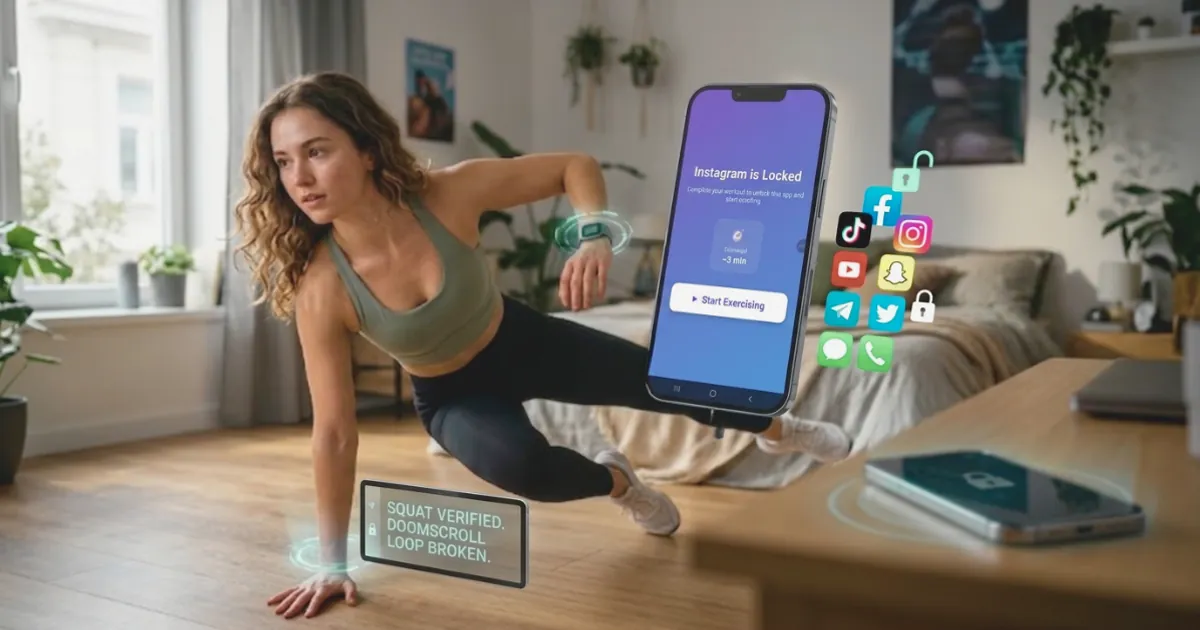
That is the model behind ScrollToll. It does not just block an app; it asks you to move your body to unlock it. Squats, pushups, a short movement session, then the app opens. No five-second skip.
Every time the pull to scroll appears, it becomes a rep instead of a relapse. The urge still happens, but it gets spent on the one thing research consistently shows lowers anxiety on its own. Strict Mode adds friction to removing a blocked app as well as opening one, so a hard day cannot quietly undo the rules you set on a clear one.
Practical steps that work alongside it, at any age:
- Screens out of the bedroom 30 to 60 minutes before sleep
- Device-free meals, adults included
- Set limits before the screen turns on, not while trying to turn it off
- Replace rather than remove, since a limit without an alternative fails
Related reading
- How Screen Time Is Killing Your Productivity
- How to Build a Healthier Phone Routine in 7 Days
- How to Stop Scrolling TikTok at Night
- How to Reduce Screen Time From 5 Hours to 2
Ready to turn your scroll habit into your workout habit? Try ScrollToll today.
Frequently Asked Questions
Is 5 hours of screen time a day bad for adults?
Not automatically. There is no evidence-based hour threshold for adults. Five hours becomes a problem when most of it is passive social media use and when it displaces sleep, physical activity or in-person time. US adults average about 5 hours 16 minutes of phone use per day, so five hours is near the norm rather than extreme.
How much screen time is too much for a child?
Since 2026 the AAP no longer sets a fixed hourly limit for children aged 2 and up. It recommends about one hour per weekday of high-quality programming for ages 2 to 5, and for ages 6 and older, family-set limits that protect sleep, physical activity, homework and face-to-face relationships. Content quality and what screens are displacing matter more than the total.
What is Gen Z's average screen time?
Estimates range from about 6 hours 27 minutes of phone use per day (Harmony Healthcare IT) to around 9 hours across all devices (DataReportal), depending on what each survey counts. Gen Z is the heaviest-using generation in every dataset. Notably, 76% of Gen Z say they spend too much time on their phones.
What is the 3-6-9-12 rule for screen time?
A framework from French psychiatrist Serge Tisseron: no screens before age 3, no personal games console before 6, no unsupervised internet before 9, and no social media before 12. It focuses on developmental readiness for each type of technology rather than daily hour limits.
How long is too long on a screen?
There is no single number. The more useful test is whether screen use is displacing sleep, movement or in-person connection, and whether you can stop when you decide to. Timing matters too: each additional hour of nighttime screen use is associated with roughly 15 to 25 minutes of lost sleep.
Does too much screen time cause anxiety?
The relationship runs both ways. Anxiety drives phone use for temporary relief, and constant algorithmic stimulation raises baseline anxiety over time. That loop is why willpower alone tends to fail.
What does screen time do to your brain?
Heavy passive use is associated with shorter attention spans and disrupted sleep cycles, largely because algorithm-driven feeds are designed without natural stopping points. Documented physical effects include eye strain and neck, shoulder and back pain.
What actually helps reduce screen time and anxiety together?
Approaches that pair a physical or behavioral substitute with app access outperform pure blocking, because they address the urge rather than just denying it. ScrollToll's movement-gated unlock turns the impulse to scroll into a short exercise break.
Ready to break the loop?
Download ScrollToll and start earning your screen time through real movement.