Excessive screen time and doomscrolling are quietly destroying your focus, sleep, and output. Here is what the science says about phone addiction and productivity loss.
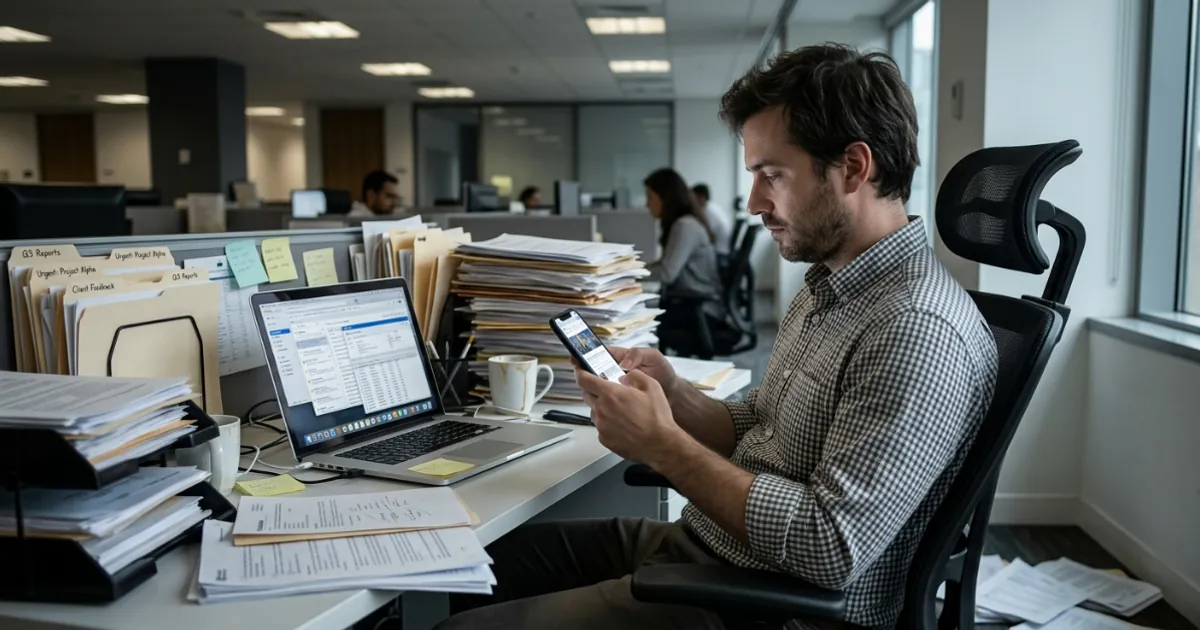
There is a moment most of us know too well. You pick up your phone to check one thing, a notification, a message, maybe the time, and somehow forty-five minutes have passed. You set it down with a vague sense of having done nothing, thought nothing, and yet your brain feels strangely exhausted.
That is not a coincidence. That is by design. And the effect of excessive screen time on your productivity is costing you far more than you realize.
Screen Time Statistics 2025: The Numbers Are Hard to Ignore
Let’s start with the scale of what we are actually dealing with.
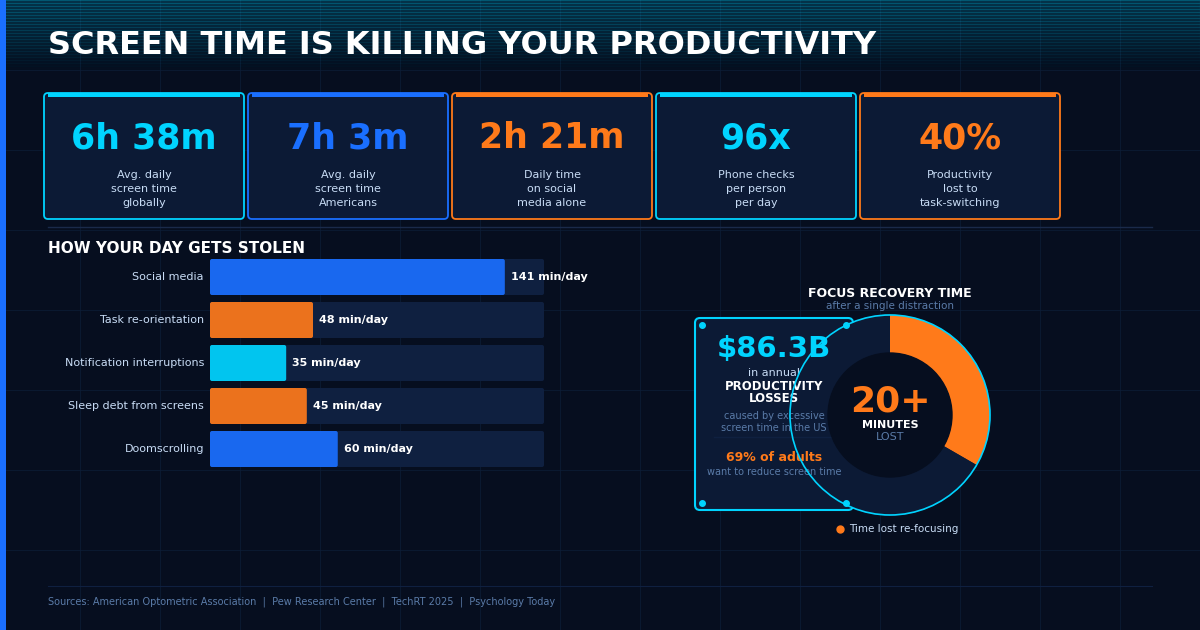
The average person on earth now spends 6 hours and 38 minutes per day on screens. The average American adult clocks closer to 7 hours and 3 minutes, more than the global average. Of that, roughly 2 hours and 21 minutes go purely to social media, every single day.
That is not background noise. That is nearly half a working day, every single day, for the rest of your life.
And if you think you are spending that time staying informed or connected, the screen time statistics tell a different story. A significant portion of that time is spent in what psychologists now call doomscrolling: the compulsive, anxiety-driven consumption of an endless feed of distressing, sensational, and algorithmically optimized content that is specifically engineered to keep you from ever putting your phone down.
The $86 Billion Productivity Problem
The relationship between screen time and productivity is not just anecdotal. It has been measured in dollars.
According to a report by the American Optometric Association, excessive screen time among American workers results in $151 billion in costs per year to health systems, productivity, and wellbeing. The single largest slice of that is productivity losses, estimated at $86.3 billion annually.
In a typical month, nearly 74% of employed Americans with screen-related eye conditions say their symptoms affect their work. More strikingly, 3 in 5 miss work entirely because of those symptoms.
But eye strain is just the visible tip of a much deeper cognitive iceberg.
Attention Span Decline: The Hidden Productivity Killer
Here is the mechanism that should alarm every knowledge worker, student, and creative professional concerned about screen time and productivity.
Research shows that after a digital distraction, it takes the average person more than 20 minutes to fully regain their focus. Meanwhile, the average worker switches tasks every few minutes, constantly interrupted by notifications, Slack messages, email alerts, and the reflexive urge to check their phone.
A 2025 study on context switching found that task-switching can reduce productivity by up to 40% due to the cognitive load of bouncing between tasks. Employees spend almost 4 hours per week, roughly 9% of their annual working time, simply reorienting themselves after switching apps and tabs.
Think about that. Nearly one in ten working days, every year, lost to context-switching alone. This is the attention span decline that no productivity system can fix if screen habits are left unaddressed.
How Doomscrolling Effects Rewire Your Brain
This is where the science of phone addiction gets neurological.
Social media platforms do not accidentally capture your attention. They are engineered to. The teams behind these apps employed psychologists, neuroscientists, and behavioral economists specifically to understand and exploit the brain's reward system. The result is a product that triggers small, irregular dopamine hits with every scroll, every like, every new piece of content. Researchers call this a dopamine loop, a cycle that mirrors the same neurological mechanics as a slot machine.
The brain adapts. It starts craving that constant stimulation. And when it cannot get it, slower, deeper tasks like reading, thinking, writing, and problem-solving begin to feel unbearably boring by comparison.
The doomscrolling effects extend beyond distraction. Studies have linked excessive short-form video consumption specifically to attentional deficits, impaired executive control, and working memory problems. The brain literally becomes less capable of sustained, deep work focus the more it is trained to expect fast, emotionally charged content.
Doomscrolling also overloads your working memory with distressing information, triggering a low-level fight-or-flight response that fills cognitive bandwidth with anxiety and leaves very little room for productive thought.
Screen Time and Sleep: The Cycle That Destroys Your Next Day
Productivity is not just about what happens while you are awake. It is built during sleep.
Blue light from screens suppresses melatonin production, the hormone that signals your body to sleep, by up to 60 minutes. Having a phone in the bedroom correlates with a 45-minute average delay in sleep onset.
The social media addiction cycle compounds this further. Doomscrolling before bed elevates stress hormones, triggers the fight-or-flight response, and prevents the brain from winding down. Poor sleep then reduces cognitive function the next day: concentration, memory consolidation, emotional regulation, and decision-making all suffer. Which makes you more susceptible to distraction, more likely to reach for your phone, and more likely to repeat the cycle.
This is why any serious conversation about screen time and productivity has to include sleep. The two are inseparable.
The Multitasking Myth and Social Media Addiction
There is a widespread belief that heavy phone users are simply multitasking, staying productive while staying connected. The science is unambiguous: that belief is false.
Brain studies consistently show that what we experience as multitasking is actually rapid task-switching, and it actively reduces the quality of every task involved. It increases cognitive load, decreases memory retention, and produces work that is measurably worse than focused, single-task effort.
What feels like efficiency is very often reduced performance in disguise. Social media addiction feeds this illusion particularly well, because the constant activity of scrolling, reacting, and checking creates a sensation of busyness that has no real productive output behind it.
How to Reduce Screen Time: It Is Not About Willpower
One of the most important things to understand when exploring how to reduce screen time is that framing it as a personal discipline failure completely misses the point.
You are not weak for finding it hard to put your phone down. You are one person competing against platforms backed by billion-dollar budgets, teams of behavioral scientists, and algorithms that optimize for one thing above all else: keeping your eyes on the screen for as long as possible.
The average user checks their phone 96 times per day. A 2024 Pew Research survey found that 69% of Americans ages 18 to 29 want to reduce their screen time but are struggling to actually do it.
That gap between intention and behavior is not a character flaw. It is the intended outcome of a system designed to override your intentions. Effective digital wellness starts with understanding this, not blaming yourself for it.
The Quiet Cost of Screen Time on Productivity
Perhaps the most insidious thing about screen time and productivity is how invisible the damage is. Nobody announces that they are going to spend the next three hours drifting in and out of focus because of their morning phone habit. The lost work does not show up on a ledger. The ideas you never had because your brain was too saturated to think deeply, those never get counted.
But they accumulate. Day after day, the hours blur, deep work focus never happens, and a gnawing sense of busyness without meaningful output quietly takes root.
We live in an era with more tools for communication and information access than ever before. Yet surveys consistently show people feeling less focused, less creative, and less satisfied with their output than in previous generations.
That tension is not a mystery. It is the cost of a habit we have normalized.
Digital Wellness: What the Research Actually Recommends
The good news is that the brain is adaptable. The habits that form can also be reformed. Researchers and behavioral scientists studying phone addiction and screen time point to a few consistent, evidence-backed principles for digital wellness:
Intentional use over total restriction. Complete abstinence from screens is neither realistic nor the goal. The evidence supports intentional use, knowing why you are picking up your phone before you do it, over mindless, reflexive scrolling.
Protecting deep work focus windows. Designating stretches of time that are free from notifications and device interruptions is consistently associated with higher quality work output and greater cognitive satisfaction.
Physical movement as a cognitive reset. Research on attention restoration shows that physical movement, even brief, helps the brain disengage from digital overstimulation and recover its capacity for focus. This is one of the simplest and most evidence-backed digital detox strategies available.
Consistent sleep hygiene. Creating a firm boundary between screens and sleep is one of the highest-leverage interventions available, with cascading benefits for focus, mood, and decision-making the following day.
Awareness as the first step toward reducing screen time. Studies show that simply tracking screen usage shifts behavior. When people see the actual numbers, many report genuine surprise and genuine motivation to change.
The Bottom Line on Screen Time and Productivity
Your attention is a finite resource. It is, arguably, your most valuable one. Everything you build, create, learn, or accomplish runs through it first.
The current digital environment is designed, with extraordinary sophistication, to erode that resource continuously. Understanding the mechanisms behind phone addiction, doomscrolling effects, and attention span decline is not about guilt. It is about making conscious choices in an environment optimized to make you anything but conscious.
The productivity you are looking for is not hiding in another app, another optimization system, or another morning routine hack. It is already there, waiting in the focus you recover when you stop letting the scroll decide where your mind goes.
A digital detox does not have to mean deleting everything. It means reclaiming the hours that are already yours.
Evidence & References
Ready to break the loop?
Download ScrollToll and start earning your screen time through real movement.