Inside the growing debate over AI, screen time, and whether the cure can ever come from the same place as the disease.
There is a version of you from ten years ago who would find your current phone habits alarming. Not the amount of content you consume, but the mechanical, almost involuntary nature of how you reach for your screen. You wake up and check it before your eyes have fully adjusted to the light. You pick it up in the middle of conversations. You open Instagram, close it, and open it again thirty seconds later without any memory of doing so.
This is not a personal failing. It is a design outcome, and it was very much intentional.
How the habit loop was engineered
The concept of a habit loop, popularized by Charles Duhigg and rooted in decades of behavioral psychology, follows a simple structure: a cue triggers a routine, which produces a reward, which reinforces the cue. It is how humans learn anything, from brushing teeth to driving a car. It is also, as Silicon Valley discovered, an extraordinarily useful framework for building products people cannot put down.
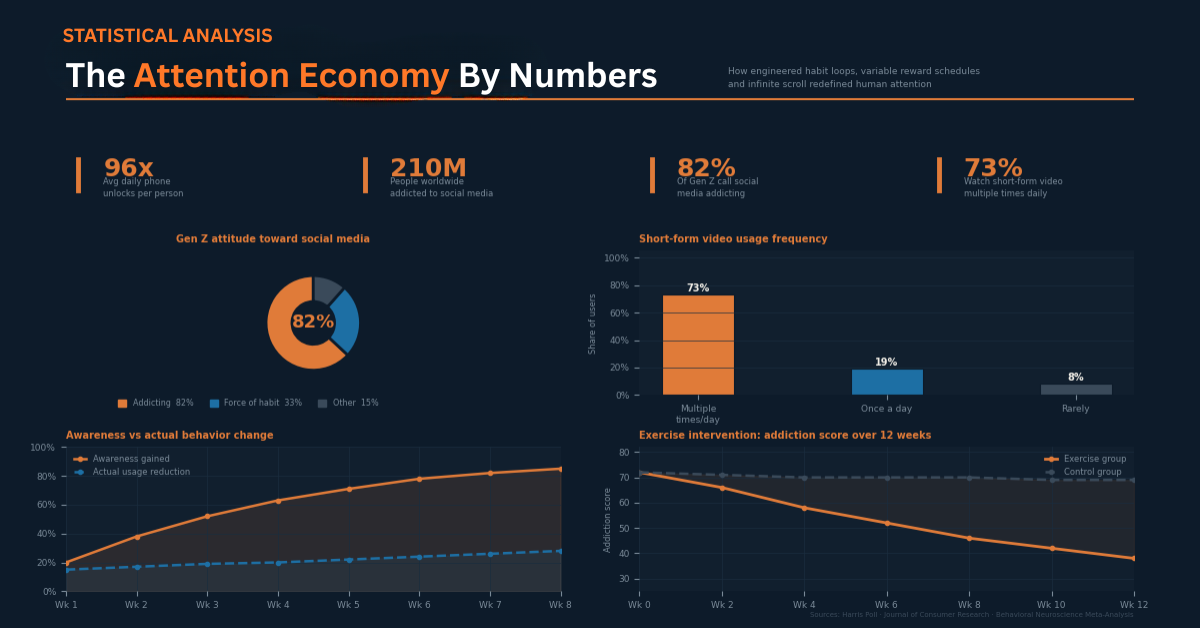
Social media platforms were not accidentally addictive. They were deliberately engineered using variable reward schedules, the same psychological mechanism that makes slot machines so effective. The average person now unlocks their phone 96 times a day, driven by habit loops, dopamine responses, and infinite scroll design. According to the Harris Poll, 82 percent of Gen Z respondents associate social media with the word "addicting," and about a third admit they use it simply because it has become a force of habit.
Globally, around 210 million people are estimated to be addicted to social media and the internet. These are not casual users who simply enjoy their phones. These are people who have lost meaningful autonomy over a core daily behavior, often without realising when or how it happened.
Why awareness alone does not change behavior
For years, the dominant response to screen time concerns was information. Track your usage. See the numbers. Feel appropriately guilty. Change.
Except it does not work that way. Research published in the Journal of the Association for Consumer Research found that screen time tracking improves digital self-awareness but is significantly less likely to lead to an actual reduction in mobile usage. Knowing you spent four hours on your phone yesterday does not stop you from spending four hours on it today. The habit loop does not respond to information. It responds to interruption.
This is the core flaw in how the tech industry has approached screen time management. Screen time dashboards, built-in app timers, and gentle nudges are all passive interventions. They inform. They do not interrupt. And because the platforms delivering those nudges have a commercial interest in keeping you engaged, the interventions are designed to be easy to dismiss.
The role of AI: accelerant and, potentially, antidote
Artificial intelligence sits at the center of this problem in two contradictory ways. On one hand, AI is what made social media addiction so precise. Recommendation algorithms can now build a personalized engagement loop for each of the five billion people online, tuned to individual psychological patterns and updated in real time. A survey found that 73 percent of users watch short-form video multiple times per day, locked into what researchers describe as powerful habit-forming engagement loops.
On the other hand, AI is increasingly being positioned as the solution. A wave of digital wellness tools now uses machine learning to track behavioral patterns, identify usage triggers, and intervene before the habit loop completes. Researchers have demonstrated that predictive, behavior-aware systems trained on session duration, scrolling intensity, and time-based usage patterns can effectively identify when a user is entering an addictive scrolling state. The feasibility of this approach has been validated under controlled conditions, pointing toward a future where AI does not just observe your habits but actively interrupts them.
Behavioral science points toward a different kind of intervention
The most compelling research on screen time reduction does not come from the technology sector. It comes from exercise science and behavioral psychology.
Research in neurophysiology has shown that physical activity can restore and regulate highly activated neuronal cells, thereby enhancing the adaptive capacity of phone-addicted individuals to external changes. Prolonged exercise fosters reward-related neuroplasticity in brain structures. In plain language: exercise produces its own dopamine reward, one that is earned rather than engineered. Over time, it competes with and can begin to replace the artificial dopamine hit of a notification ping.
A meta-analysis of randomized controlled trials revealed that exercise significantly reduced adolescent mobile phone addiction. Research has also demonstrated a decline in phone addiction levels among groups that engaged in aerobic exercise, while individuals disinclined toward physical activity were more susceptible to developing addictive mobile phone behaviors compared to their active counterparts.
What this body of research points toward is a model of intervention that most digital wellness tools have not yet attempted: using physical activity not as a complement to screen time reduction, but as a direct prerequisite to it.
Earning access instead of being denied it
This is the logic behind a new approach to social media restriction, one that flips the traditional model on its head. Rather than blocking access outright, which generates frustration and resentment, the framework asks users to earn their scrolling time through physical effort. One completed repetition of an exercise equals one minute of social media access. Ten reps, ten minutes. The access is real. So is the cost.
Tools built on this principle, like ScrollToll, use AI not to track your content consumption or send you wellness reports, but to verify that the physical activity is genuine. The motion detection exists for one reason: to ensure the trade is honest. Without verification, the habit loop finds a shortcut. With it, the interruption becomes real.
This is operant conditioning applied in reverse. Social media platforms spent years using intermittent rewards to hook users. This model uses the same psychology to retrain the reward pathway, attaching the dopamine hit of social media access to a behavior, physical effort, that produces its own neurological benefits. The brain begins to associate the work with the reward, and over time, the value of both shifts.
What this means for the future of digital wellness
The honest question hanging over all of this is one of incentives. Screen time management tools built by the same platforms that profit from engagement will always face a structural conflict of interest. The most credible interventions are the ones with nothing to protect, no algorithm to maintain, no engagement metric to defend.
The research increasingly supports an approach that is physical, friction-based, and honest about what it is asking. Not awareness. Not tracking. Actual behavioral change, built into the architecture of access itself.
We built our phone habits one unconscious unlock at a time. Rebuilding them will take the same patience, one conscious choice at a time. The difference is that now, for the first time, technology exists to make that choice unavoidable.
Whether we choose to use it is, fittingly, still up to us.
Evidence & References
Ready to break the loop?
Download ScrollToll and start earning your screen time through real movement.