We talk about what social media does to our mental health and attention spans, but almost never about what it is physically doing to our eyes. Here is what the science says — and what you can do about it.
You probably didn’t wake up this morning thinking about your eyes. You just picked up your phone. Maybe checked Instagram before you even got out of bed. Scrolled through TikTok while eating breakfast. And by noon, without realizing it, your eyes had already done more work than they were ever designed to do before lunch.
We talk a lot about what social media does to our mental health, our attention spans, our sleep. But we almost never talk about what it is physically doing to our eyes. And honestly, that’s a conversation we are long overdue for.
What Is Actually Happening When You Scroll
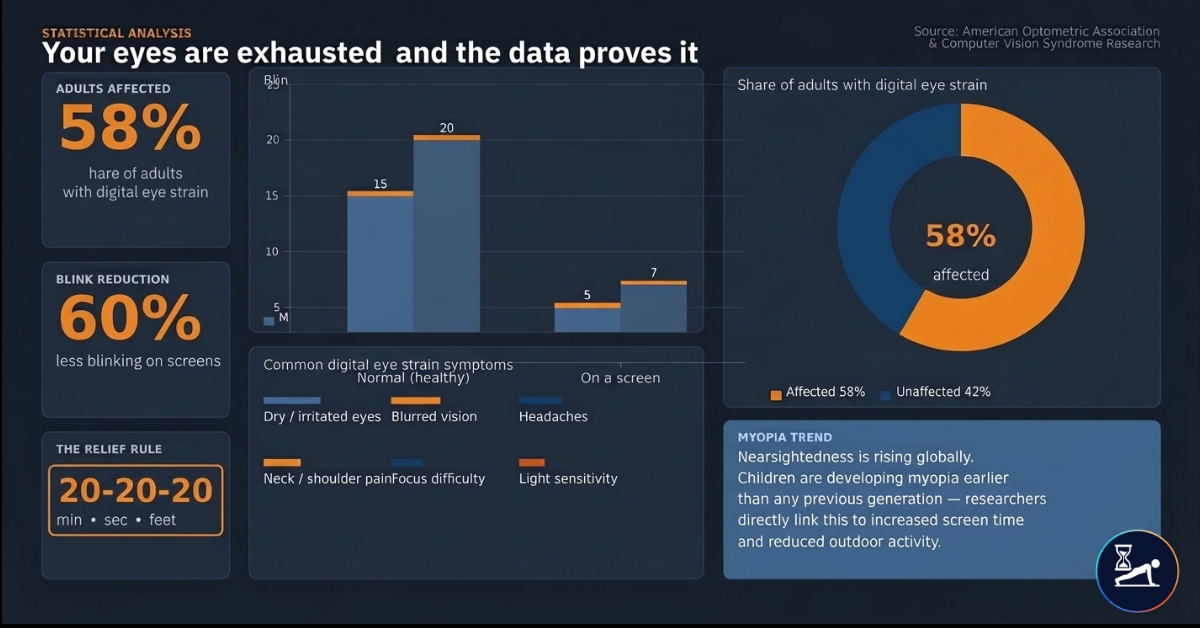
Here is something most people don’t know. When you stare at a screen, you blink about 60% less than you normally would. Normally, a healthy person blinks around 15 to 20 times a minute. In front of a screen, that drops to somewhere between 5 and 7 times.
Blinking isn’t just a reflex. It’s how your eyes stay lubricated, clean and protected. When you stop blinking enough, the tear film on your eye dries out. The surface of your eye gets exposed. And that’s when you start feeling it: the burning, the itching, the heaviness that you’ve probably been chalking up to tiredness.
That’s not tiredness. That’s your eyes telling you they are genuinely hurting.
Digital Eye Strain Is Real and It Is Very Common
The clinical term is Computer Vision Syndrome, but doctors also call it digital eye strain. And according to the American Optometric Association, it affects around 58% of adults who use digital devices regularly. Which at this point is nearly everyone.
The symptoms of digital eye strain include dry, red or irritated eyes, blurred vision after long screen sessions, headaches (especially around the temples or behind the eyes), neck and shoulder pain from leaning into your screen, difficulty focusing when you look up from your phone, and a new sensitivity to light that wasn’t there before.
If you are reading this list and nodding along, you are not alone. Most people living with these symptoms have just accepted them as part of daily life. They shouldn’t have to.
Why Social Media Makes It Worse Than Regular Screen Time
Not all screen time affects your eyes equally. Reading a document or writing an email is actually gentler on your eyes compared to social media scrolling. Here is why.
When you scroll through a social media feed, your eyes are constantly in motion. The content is always changing. Bright videos autoplay. The contrast between dark backgrounds and bright text shifts constantly. Your eyes have to continuously refocus, adjust to new light levels, and track fast moving visuals.
It is the visual equivalent of running a sprint every few seconds for hours straight.
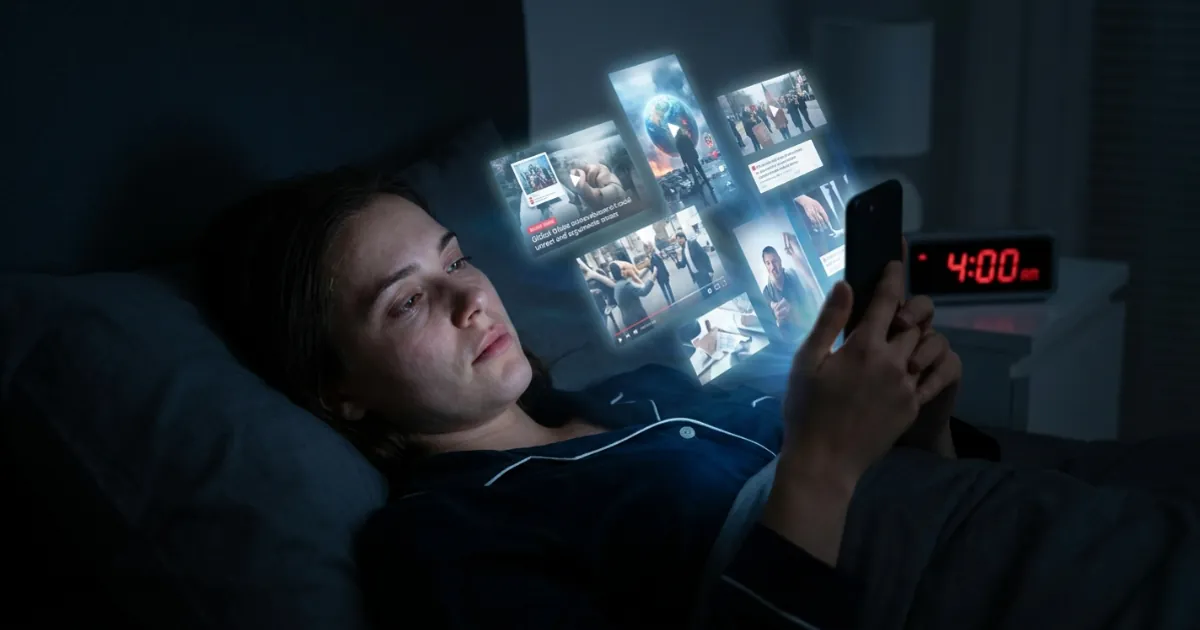
Add to that the fact that most of us use our phones in bed, in the dark, with the screen brightness turned way up. Your pupils are dilated for low light and then you are blasting them with a bright glowing screen inches from your face. That kind of contrast stress is exhausting for your visual system in a way that adds up very fast.
Blue Light Is Part of the Problem, But Not the Whole Story
You have probably heard about blue light by now. It’s the high energy visible light that screens emit, and it does play a role in eye strain and sleep disruption. Blue light interferes with your body’s melatonin production, which is why scrolling before bed makes it harder to fall asleep and even harder to feel rested in the morning.
But blue light blocking glasses, while helpful, are not a full solution. The real issue is the duration and the pattern of use. No amount of blue light filtering fixes the fact that you have been staring at a screen for four hours without a real break.
The problem is time. And the problem is habit.
The 20-20-20 Rule Exists for a Reason
Eye care specialists have been recommending this for years. Every 20 minutes, look at something 20 feet away for at least 20 seconds. It gives your eye muscles a chance to relax and resets the focusing cycle that gets stuck when you stare at something close for too long.
It sounds simple. And it is. But try actually doing it the next time you are deep in a scroll session. You will probably forget within the first five minutes. That’s not a character flaw. That’s just what happens when an app is designed to hold your attention as long as physically possible.
The apps are not built with your eye health in mind. They are built with engagement metrics in mind. Those are very different goals.
What Long Term Screen Overuse Can Lead To
Short term eye strain is uncomfortable. But the more worrying conversation is about what happens when this becomes the pattern for years. Research into the long term effects of excessive screen time on vision is still growing, but what we already know is not reassuring.
Myopia, also known as nearsightedness, is increasing globally at a rate that researchers directly link to increased screen exposure, particularly in younger people. Children who spend more time on screens and less time outdoors are developing myopia earlier and at higher rates than any previous generation.
Chronic dry eye disease is also on the rise. What used to be something older adults dealt with is now increasingly common in people in their 20s and 30s.
Your eyes are not invincible. They are sensitive, complex organs and they are absorbing a workload right now that would have been unimaginable to any generation before ours.
Reducing Your Screen Time Is Eye Care
We don’t often think of screen time limits as a form of physical health care. We think of it as a productivity thing, or a mental health thing. But protecting your eyes is one of the most direct physical reasons to be more intentional about how much time you spend scrolling.
Taking breaks, setting app limits, and building boundaries around your phone use isn’t just good for your focus or your sleep. It is literally good for your vision.
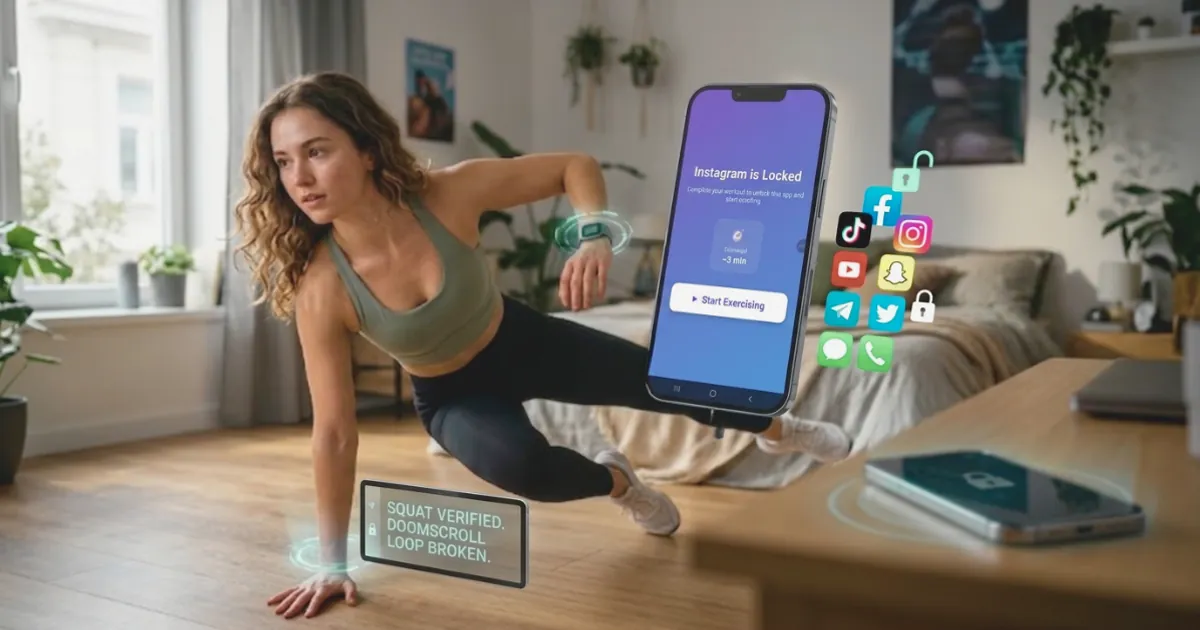
This is what ScrollToll is built around. Not guilt, not shame, just giving you back a bit of control so your habits don’t quietly run away from you. When your social media time is up, the app locks it. Your eyes get a break. Your brain gets a break. And you get to be a person again instead of just a pair of tired eyes pointed at a feed.
Small Things You Can Start Doing Today
You don’t have to overhaul your entire life. Just start somewhere.
Put your phone across the room when you go to sleep. Increase your text size so your eyes aren’t straining to read small fonts. Use night mode in the evenings. Try the 20-20-20 rule even just once today and notice how much relief it brings. And consider setting an actual time limit on your most-used apps.
Your eyes have been with you your whole life. They deserve a little more consideration than you’ve probably been giving them.
Evidence & References
Ready to break the loop?
Download ScrollToll and start earning your screen time through real movement.